A folder of floral photographs shows what caught your attention, but it rarely explains what matters most. One image may appeal because of its colour, another because of its scale and a third because of the room. A useful florist brief labels those reasons and connects them to your actual wedding.
Start with the event facts: date, location, guest count, spaces being used and access times. Then explain the atmosphere you want and the decisions you are comfortable leaving to the florist. Specific priorities are helpful; a rigid shopping list of flowers may be less useful if availability is uncertain.
🌸 Build a one-page design brief
| Section | What to include | What to avoid |
|---|---|---|
| Visual direction | Colour, texture, outline and degree of formality | Unlabelled reference images |
| Priority areas | Where flowers matter most to you | Assuming every space needs decoration |
| Inventory | Carried flowers, tables and installations | Undefined quantities |
| Practical needs | Access, scent preferences, mobility and room layout | Leaving constraints until setup |
| Commercial scope | Budget basis, delivery, setup and collection | Comparing flowers alone with full-service pricing |
Interflora’s published wedding packages show how several types of arrangement can sit within a coordinated order, while also stating that choices can be tailored. Use package lists as a prompt to identify what you need, not as evidence that every wedding requires the same roles or floral items.
An illustrative priority brief
Assume a fictional couple has a ceremony room, a dining room with six tables and a welcome desk. They care most about one ceremony focal point and flowers that allow conversation across dinner tables. They are less concerned about decorating the entrance or every chair.
Their brief says: ‘Prioritise a ceremony arrangement and low table flowers. We like soft green, cream and one muted accent. We prefer movement over a tightly packed outline. Please propose which flowers suit the date and tell us what can be simplified if the full design exceeds our budget.’
Under these assumptions, the first discussion covers eight placement groups: one ceremony focal point, six table groups and one welcome-desk arrangement. That is not eight identical products or a stem estimate. The florist still needs to define the scale, vessels, mechanics and labour for each group.
Prepare the consultation in order
- Collect a small set of images and label the feature you like in each.
- List the spaces and quantities that are genuinely needed.
- Rank priorities so the florist knows what to preserve if scope changes.
- Give an honest budget basis and ask what it includes.
- Share venue restrictions and access details.
- Ask for a proposal with assumptions, substitutions and exclusions.
- Record decisions and unresolved questions after the meeting.
If your budget is not settled, say so and request a staged scope rather than asking for an unlimited concept. Clarify whether the figure includes tax, vessels, delivery, setup, collection and any room move. The same total can buy very different services under different assumptions.
Include the less photogenic constraints
Ask the venue about fixing methods, permitted materials, fire routes and removal deadlines. The florist needs those answers before proposing suspended or freestanding work. Any structural or installation assessment belongs to the relevant professionals, not an improvised plan based on a photograph.
Fresh materials also need suitable handling. Chrysal’s guidance explains that transport conditions and post-harvest care influence quality. Tell the florist if the room is exposed to heat, the access route is long or there is nowhere suitable to hold arrangements before installation. Do not assume the venue can provide flower storage.
The takeaway is to brief for collaboration. When the florist knows your priorities, practical conditions and approval boundaries, they can propose a design that belongs to your event rather than trying to reproduce an unexplained collection of images.
Sources and further reading
Photograph credit
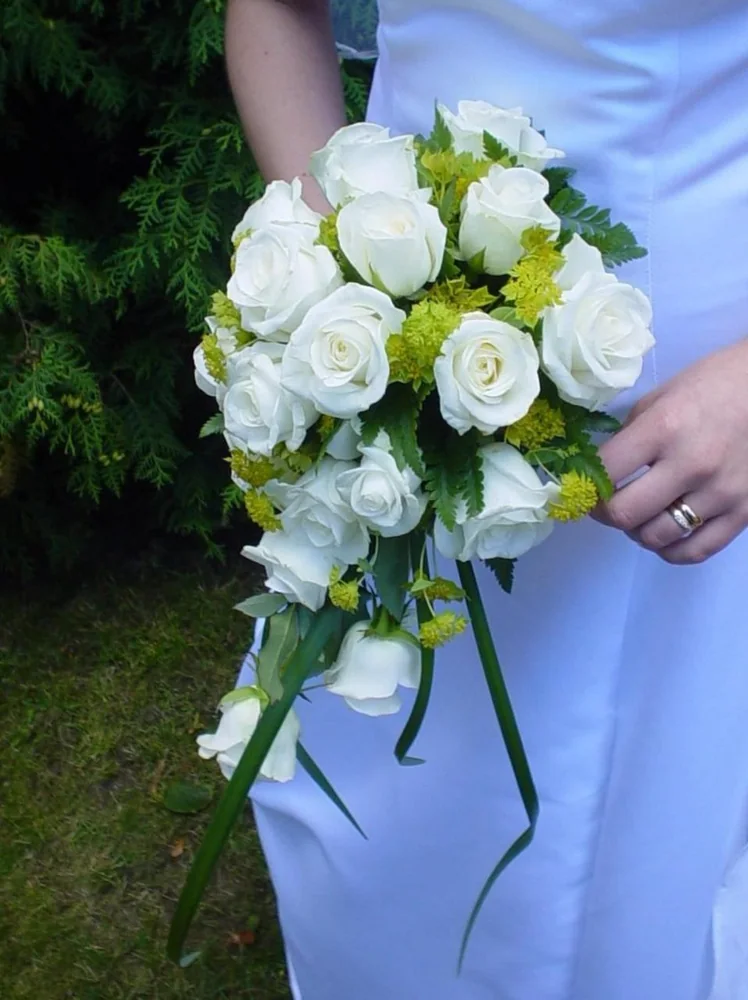
A cascading white rose bouquet carried by a bride. Photo: Rosendahl, Wedding bouquet white roses.jpg, Public domain. Resized and converted to WebP; the image remains available under its original licence. This is an illustrative photograph, not a Vowlinora case study or a photograph of the worked example.
