Two proposals can both promise ‘ten centrepieces’ and still describe very different results. Vessel size, flower density, mechanics, installation time and collection arrangements all matter. Comparing only the named flowers risks missing the services that make the design possible.
Begin by giving each florist the same brief. Ask them to identify where they have interpreted the scope differently. A creative alternative can be valuable, but it should be visible as an alternative rather than hidden inside a superficially similar total.
📋 Compare the arrangement and the service
| Proposal element | What to clarify | Why it changes the comparison |
|---|---|---|
| Quantity and placement | Exact groups and intended locations | A table cluster is not one single vase |
| Scale and visual density | Approximate dimensions and reference | Identical labels can conceal different impact |
| Vessels and mechanics | Hire, purchase, ownership and return | Replacement and collection costs may differ |
| Flowers | Expected materials versus guaranteed elements | Availability and substitutions affect design |
| Labour and logistics | Delivery, setup, room moves and removal | Flowers alone are not a full-service installation |
Interflora’s wedding-package information illustrates that floral orders can combine bouquets, wearable flowers and arrangements, and that selections can be tailored. The lesson for comparison is to make the combination explicit rather than assuming a package name defines a universal scope.
A numerical comparison without invented prices
For an illustrative wedding with ten tables, Proposal A includes three small vessels per table. Proposal B includes one larger arrangement per table. That means 30 vessels in A and ten arrangements in B. It does not mean A has three times the floral value, flower quantity or labour.
The couple asks for approximate group dimensions and a description of visual density. They also discover that A includes vessel hire and collection, while B assumes the couple supplies containers. Those assumptions need aligning before either total can be understood. This example deliberately uses no market prices.
If the couple prefers the smaller-vessel look, they ask whether B can quote that same approach. If they prefer the larger focal arrangement, they ask A for that option. Comparing like with like can reveal whether a difference comes from design, service or commercial terms rather than from the florist’s headline price.
Agree substitution boundaries
- Separate sentimental must-haves from preferred colours and textures.
- Ask which flowers are expected but subject to availability.
- Define substitutions by visual role, scale and colour family.
- Identify changes that need approval before purchase.
- Agree what happens if an alternative changes the cost.
- Record the final framework in the proposal or contract.
A useful instruction might be: ‘Preserve the loose cream-and-green palette; ask before adding strongly saturated colours or replacing the focal flower with a markedly different form.’ The precise wording should reflect your priorities. Avoid demanding that a living material match a reference image exactly in shade and size.
Make quality and responsibility visible
Chrysal explains that flower type, growing conditions, post-harvest handling and transport all influence vase life. A proposal with a long list of desirable varieties does not by itself establish the quality or suitability of the final arrangements. Ask how the design fits your setup window and room conditions.
Check who owns hired items, who packs them after the event and what happens if a guest takes a vessel home. Confirm access times and whether removal is included at the venue’s required hour. A late-night collection can be a separate service, not an automatic part of delivery.
If a sample arrangement is offered, ask what it demonstrates and whether substitutions remain possible. A sample is not a guarantee of identical flowers months later. Use it to clarify scale and style while retaining the agreed availability framework.
The takeaway is to compare defined outcomes and responsibilities. A clear proposal should tell you what will appear, who will install and remove it, and how inevitable material variation will be handled.
Sources and further reading
Photograph credit
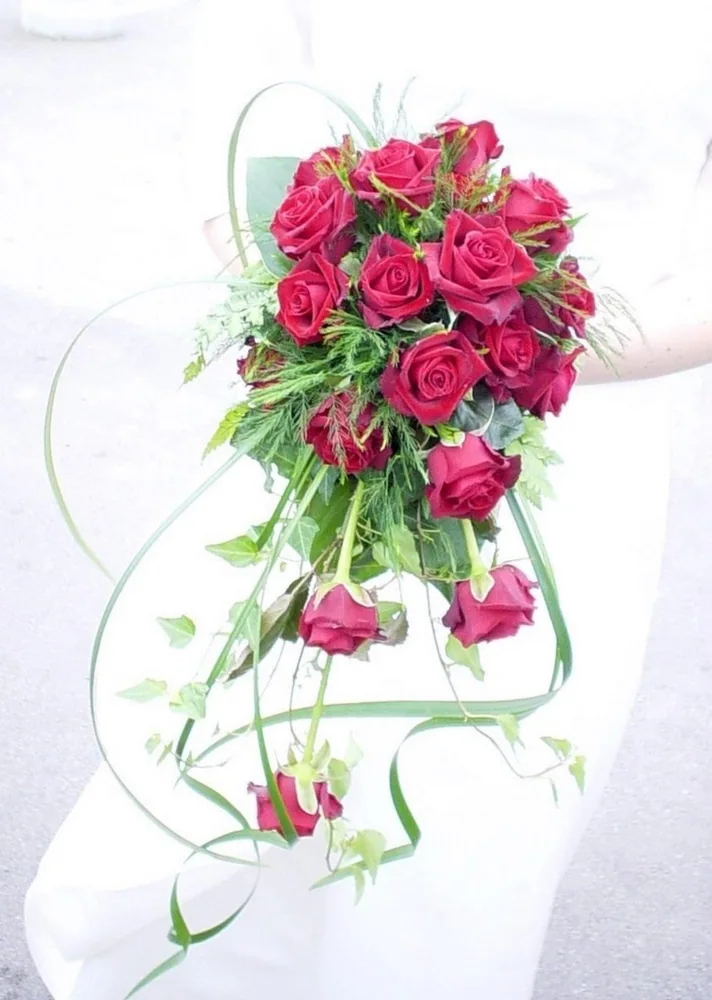
A cascading red rose bouquet held against a white wedding dress. Photo: Rosendahl, Wedding bouquet red reses.jpg, Public domain. Resized and converted to WebP; the image remains available under its original licence. This is an illustrative photograph, not a Vowlinora case study or a photograph of the worked example.
