A request for less fragrance deserves a practical conversation, not a list of supposedly safe flowers. People can have different reactions to pollen, scents and materials used around arrangements. A species name alone cannot establish that a bouquet or room will be comfortable for a particular person.
Ask what the person wants you to know and what arrangements would help. They may prefer no flowers at their table, a less scented room, distance from a large installation or a non-floral option. Do not ask them to prove a diagnosis to justify a reasonable planning discussion.
🌿 Separate the concerns
| Concern raised | Useful planning question | Who should advise |
|---|---|---|
| Strong fragrance | Which spaces or carried items should avoid scent? | Person affected and florist |
| Pollen concern | What specific exposure needs discussion? | Person affected and their clinician where needed |
| Contact with materials | Will flowers touch skin, clothes or equipment? | Person affected and florist |
| General uncertainty | Would a non-floral arrangement be preferable? | Person affected and organiser |
The American Academy of Allergy, Asthma and Immunology notes that flower odours can trigger symptoms for some people, even when the pollen from certain showy flowers is less likely to cause typical airborne allergy symptoms. That distinction is a reason to listen carefully, not a basis for declaring roses or any other flower safe for everyone.
A fictional planning conversation
Assume, illustratively, that one guest says strong floral scents make dining uncomfortable, while a person carrying flowers wants to avoid material brushing against their skin. The organiser records these as different needs. They do not combine them into a single label such as ‘flower allergy.’
The florist is asked to discuss lower-fragrance options and placement for the dining room, with the understanding that no symptom-free outcome is guaranteed. For the carried arrangement, the conversation covers handle wrapping, contact points and a possible alternative to carrying flowers. The affected people decide what feels acceptable to them.
The couple also checks other sources of scent: candles, room fragrance and perfumed welcome products. Removing a strongly scented floral arrangement while adding scented candles would not address the broader request. Ask the venue what it can control and be honest about shared spaces or other guests’ personal fragrances.
Build the plan in sequence
- Invite private communication about fragrance or material concerns.
- Clarify the practical arrangement requested without making a medical interpretation.
- Discuss flower selection, placement and alternatives with the florist.
- Check venue fragrances and other decorative products.
- Confirm the agreed plan with the affected person.
- Give the setup team clear placement instructions.
- Name a contact who can adjust an arrangement if a problem arises.
Do not conduct an improvised exposure test or encourage someone to try a flower against medical advice. A sample consultation may clarify appearance or scent preferences, but it is not an allergy assessment. Medical questions and personal treatment plans belong with the person’s healthcare professional.
Alternatives do not need an apology
A table can be attractive with carefully chosen vessels, textiles, permitted candles or other non-floral objects. A person can choose not to carry a bouquet. These are design options, not inferior substitutes. Check all alternatives against venue rules, stability and fire-safety requirements.
Dried flowers are not automatically a solution. Do not label them hypoallergenic or assume that a preserved product contains no fragrance, dust or treatment. Ask the supplier what the material is and how it has been treated, while recognising that this still does not establish individual suitability.
Plant handling also has non-allergy considerations. RHS guidance warns that some cut-flower plants are poisonous or can irritate skin. Keep decorative materials away from food and discuss wearable or cake-adjacent flowers with the relevant professionals.
The takeaway is to replace broad reassurance with specific, respectful planning. Listen to the person, involve the florist and offer genuine alternatives without promising that any flower or material is universally safe.
Sources and further reading
Photograph credit
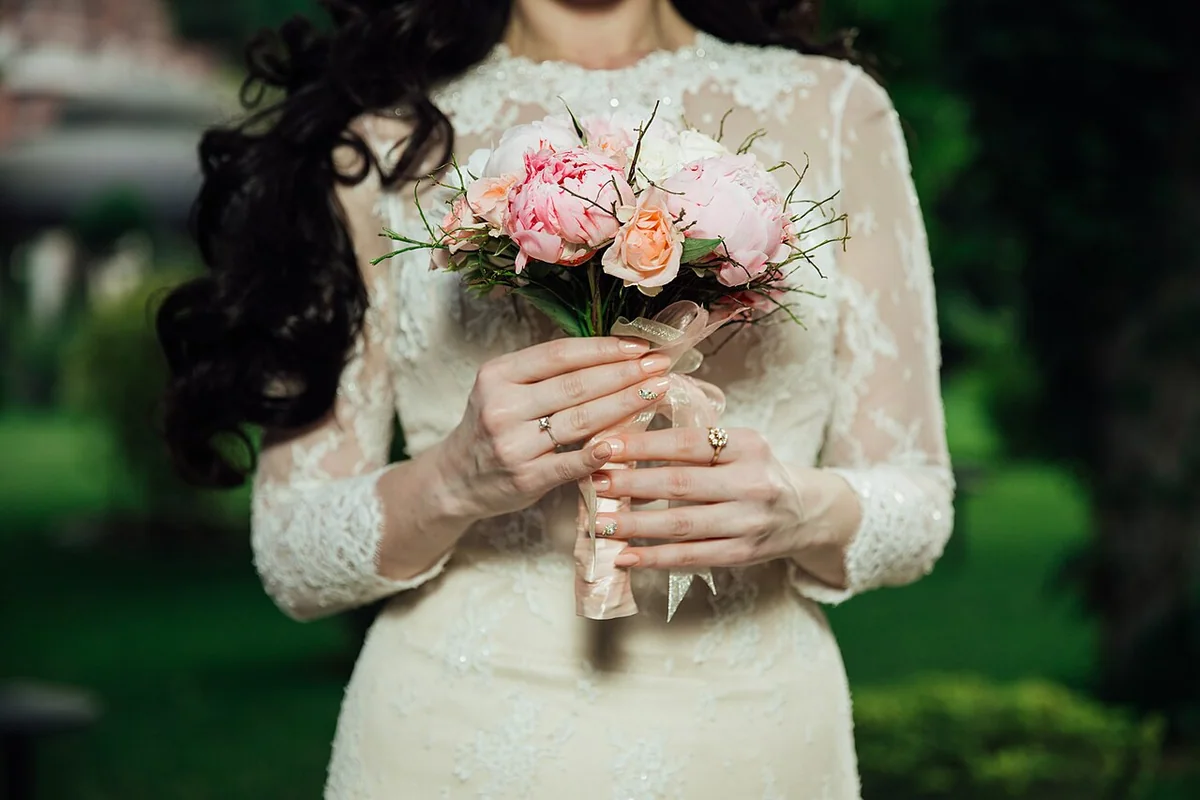
A bride holding a small bouquet of pale roses and greenery. Photo: Alvin Mahmudov alvinmahmudov, 22, Bridal bouquet (Unsplash).jpg, CC0. Resized and converted to WebP; the image remains available under its original licence. This is an illustrative photograph, not a Vowlinora case study or a photograph of the worked example.
