Fresh and dried flowers create different textures, but the choice reaches beyond appearance. It affects preparation, transport, storage, cleaning and what happens after the wedding. Neither category automatically means inexpensive, low-maintenance or environmentally preferable.
Ask the supplier to describe the actual materials. Naturally dried stems, preserved foliage, dyed flowers and mixed artificial components are not interchangeable. Knowing what a product contains helps you ask about care, colour transfer, venue approval and disposal without relying on broad labels.
🌾 Compare practical tradeoffs
| Decision area | Fresh-flower question | Dried or preserved question |
|---|---|---|
| Appearance | What stage of opening is expected? | What texture and colour variation should we expect? |
| Care | What water and environment are needed? | What humidity, handling or storage limits apply? |
| Transport | How are vessels and stems supported? | How are brittle or shedding elements protected? |
| Venue rules | Are water, fixing methods or plant materials restricted? | Are these materials permitted near heat or flame? |
| After use | Can any arrangements be gifted under the care plan? | Can the pieces be stored or reused realistically? |
RHS cut-flower guidance explains that fresh arrangements need clean vessels, suitable conditioning and attention to water and placement. Those are real planning requirements. Dried materials may remove some water-related tasks, but that does not make every product durable or suitable for every room.
An illustrative mixed-material decision
Assume a fictional couple likes a fresh carried bouquet and dried table arrangements. Their venue permits both but requires approval of decorative materials near candles. The couple asks the florist for product details and asks the venue to confirm the final layout. They do not infer fire suitability from the word ‘natural.’
The table pieces are intended to be reused at home. Before ordering, the couple identifies where they would actually go and who can store them. If nobody wants or can store the pieces, a claim of future reuse is only an intention. They compare that plan with fewer arrangements, hired vessels or other simpler décor.
The fresh bouquet still has its own care instructions. Mixing materials does not eliminate the need for a suitable resting place or transport plan. The florist should confirm whether any dried or treated elements can sit within the fresh arrangement and how the finished piece should be handled.
Choose in a defined sequence
- Describe the look and the functions you need from each arrangement.
- Ask the supplier to identify fresh, dried, preserved, dyed and artificial components.
- Check venue restrictions before committing to the design.
- Confirm transport, setup, storage and cleaning responsibilities.
- Compare complete costs, including labour and vessels.
- Make a realistic end-of-event plan for each material.
- Record any care limitations in the supplier handoff.
Do not assume dried arrangements are always cheaper. The materials, craftsmanship, mechanics and installation can be substantial. Likewise, a fresh-flower quote should include the services needed to prepare and place the work. Compare the same scale and responsibilities.
Avoid unsupported comfort and sustainability claims
Dried or preserved flowers should not be called hypoallergenic. Fragrance, dust, treatments and individual sensitivities require discussion. AAAAI notes that floral odours can cause symptoms for some people; that is a reason to ask about individual concerns, not a basis for declaring one material universally safe.
Environmental comparisons need evidence about growing, drying or preservation, transport, packaging, use and disposal. A material that can be reused is not necessarily reused, and a natural-looking stem may contain treatments that affect disposal options. Ask the supplier and local waste service rather than automatically placing mixed materials in garden waste.
Keep all decorative plants and treatments away from food unless the florist and caterer have agreed an appropriate arrangement. A dried flower is not automatically edible, and neither is a fresh one.
The takeaway is to choose material by material and task by task. A clear plan can combine fresh and dried elements thoughtfully without relying on blanket claims about cost, safety or sustainability.
Sources and further reading
Photograph credit
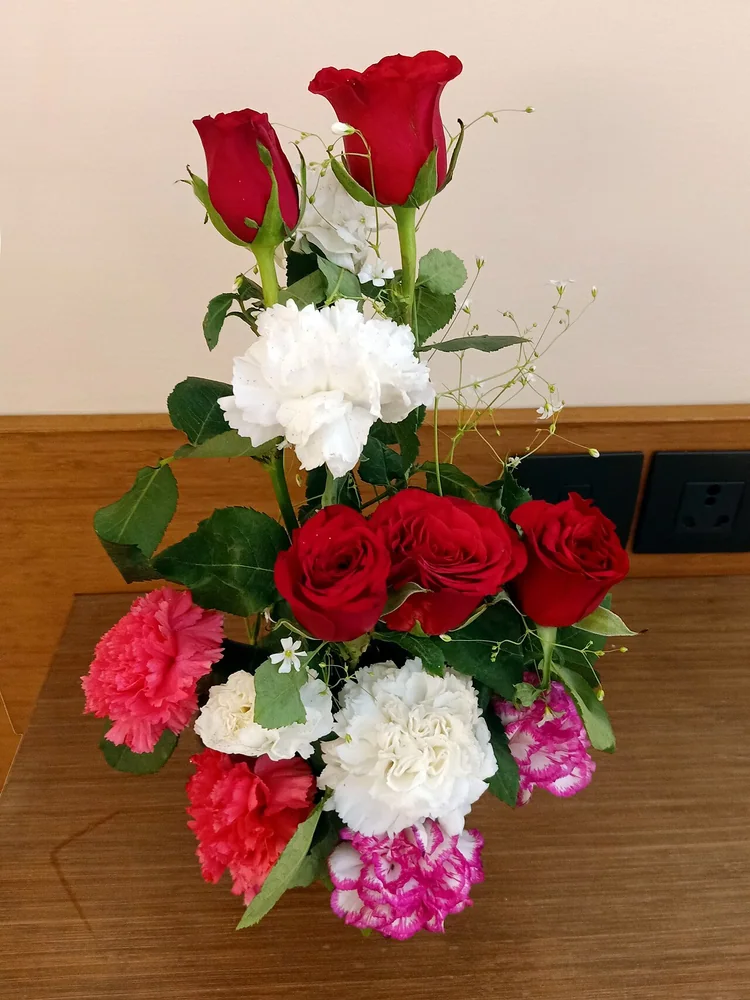
Red and white roses and carnations arranged in a vase. Photo: Suyash Dwivedi, Rose and carnation flower bouquet 01.jpg, CC BY-SA 4.0. Resized and converted to WebP; the image remains available under its original licence. This is an illustrative photograph, not a Vowlinora case study or a photograph of the worked example.
