A strong-color wedding image can make every ordinary item you already chose seem unfinished. Suddenly the chairs, glassware, ribbons, paper, and outfits appear to need coordination. The expensive part may not be the first bold element; it may be the chain of replacement purchases that follows. Evaluate the scope of adopting the idea before buying anything new.
🎨 Name the effect, not the shopping list
Ask what attracts you to the reference: energy, warmth, contrast, theatricality, or a playful mood. Those qualities do not necessarily require every object to change. You might achieve the desired emphasis through one focal element while leaving functional items alone. This is a trend-adoption exercise, not a palette-testing guide or a recommendation about which colors belong together.
Check the image’s context too. A supplier campaign or styled production may be designed to display many coordinated products at once. Photographer Anna O. Brambilla explains that styled shoots have more controlled conditions than a live wedding. That does not make their ideas unusable, but it is a reason to translate the concept rather than purchasing every visible component.
Use an adoption-boundary worksheet
| Decision | Write down | Stop condition |
|---|---|---|
| Purpose | The effect you want guests to notice | No clear improvement to that effect |
| Anchor | The one element carrying the statement | Additional items merely duplicate it |
| Existing items | What remains unchanged | Replacement would discard a usable choice |
| Extras | Delivery, handling, installation, and removal | Unconfirmed requirements or responsibility |
| Allowance | A fixed discretionary limit | New purchases exceed the agreed limit |
Discuss dependencies with suppliers. A larger installation may need different equipment, handling, or venue permission. Colored rentals may have minimum quantities or return conditions. Do not assume that the photographed object is the entire service. Ask what changes operationally and what can remain exactly as planned.
A change register that includes existing commitments
Assume a fictional couple has already paid 90 units for usable printed stationery. Their neutral linens and glassware are booked. They now allow 180 additional units to introduce one statement-colour feature. These invented units demonstrate change control, not real prices, refund rights or a recommended budget.
| Item or dependency | Retain-and-anchor option | Wider replacement option | Confirmation needed |
|---|---|---|---|
| Existing stationery | Keep the paid 90-unit suite; add one focal print for 120 | Replace the suite with new printing for 150 | Proof approval and printer deadline |
| Booked linens | Keep unchanged | New colour adds 160 | Rental availability and approved specification |
| Booked glassware | Keep unchanged | New colour adds 120 | Quantity, tabletop fit and supplier scope |
| Supporting logistics | Agreed print placement/handling adds 30 | Additional delivery/handling adds 50 | Venue-approved support and named receiving team |
| New spending | 120 + 30 = 150 | 150 + 160 + 120 + 50 = 480 | No other compulsory charges assumed here |
The narrow option leaves 30 units inside the 180-unit new-spending limit. The wider option exceeds it by 300. Under this fictional agreement, no old payment is recovered and the wider option makes the already paid 90-unit stationery unusable. Record that sunk spend separately; adding it again to the 480-unit future cash requirement would double-count it.
The couple chooses the focal print and keeps the original suite, linens and glasses. Approval remains conditional on the venue accepting the support and position and the printer meeting the agreed deadline. If either fails, the fallback is the existing decor, not a last-minute replacement spree. The colour idea is optional even after someone has made an attractive mockup.
Copy the register with these fields: current item and paid/committed amount; proposed change; recoverable amount confirmed under the actual terms; new cash due and date; affected supplier; venue approval; decision owner; accept/decline and fallback. An existing payment is not available spending money simply because you stop using the object.
This is control of a change to an already approved plan. If you have not allocated the original decor budget yet, use the initial decor-priority worksheet. To check the actual manufactured colours before ordering, use the material palette test; neither a spending register nor a reference photograph approves the physical result.
Ask whether the reference is selling urgency
The US FTC’s influencer-disclosure guidance explains material commercial connections in endorsements. It is not an international rulebook, but it helps frame a useful reading question: is this recommendation independent inspiration, paid promotion, or a supplier showing its own inventory? Commercial context does not invalidate the idea. It simply should not be mistaken for proof that your existing choices are obsolete.
- Identify the desired visual effect in one sentence.
- Choose an anchor rather than a complete coordinated shopping list.
- Ask suppliers about dependencies and exclusions.
- Compare the full incremental commitment with your chosen allowance.
- Keep a written list of items that will not be changed.
A deliberate limit can also protect coherence. Too many repeated accents may dilute the focal point you liked in the first place. You do not need to purchase a matching version of every functional object to show that a color choice was intentional.
No spending worksheet can tell you whether the result will feel right, and no reference guarantees identical appearance in another room. The useful takeaway is control: adopt a clear idea, understand its consequences, and give yourself permission to stop before inspiration turns into an obligation to replace everything.
Sources and further reading
Photograph credit
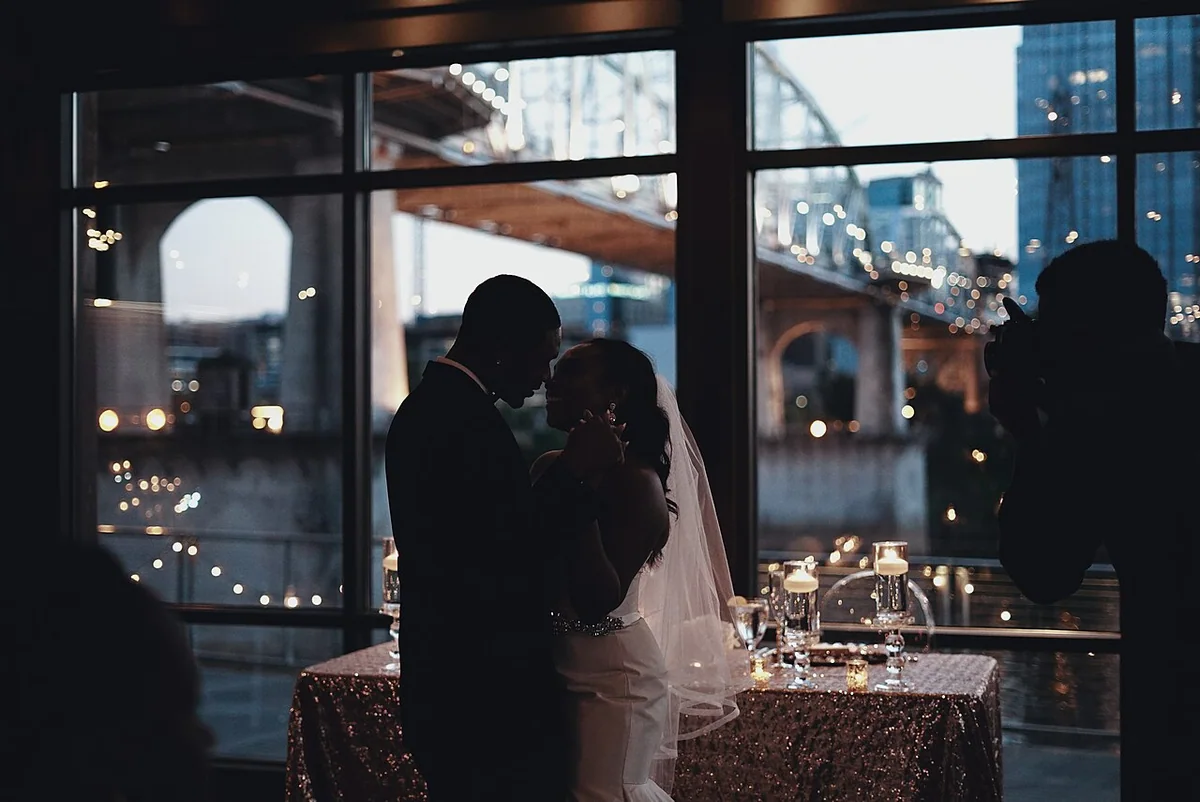
A wedding couple silhouetted inside a reception space at dusk. Photo: Andre Hunter dre0316, Lets Live Here Forever (Unsplash).jpg, CC0. Resized and converted to WebP; the image remains available under its original licence. This is an illustrative photograph, not a Vowlinora case study or a photograph of the worked example.
