
A restricted decor budget often becomes harder to use when every saved photograph introduces another item. Miniature spending across entrances, chairs, ceilings, tables and favours can produce many obligations without a clear visual idea. Start by choosing the places where decoration will do the most work for your particular event.
BRIDES advises that couples do not need every optional wedding element and can prioritise fewer things done well. That is a budgeting principle, not a universal aesthetic rule. Minimal decoration can be colourful, personal or elaborate in one area; it does not have to mean an all-white room.
✨ Rank zones by purpose
Walk the venue and identify what already contributes to the setting: architecture, views, furniture or existing finishes. Then identify the places guests will spend time and the information they need. Do not pay to cover a feature you already like simply because an inspiration image uses a backdrop.
- List potential decorating zones.
- Describe the job each zone should perform.
- Choose three priorities that support your event.
- Request complete costs, including setup and removal.
- Remove optional items before reducing practical essentials.
- Check that the remaining pieces share a clear visual relationship.
Functional lighting, approved circulation and readable directions are not styling leftovers. Confirm those with the venue before allocating the entire decor allowance to flowers or objects. A budget priority does not override access or safety requirements.
A worked 900-unit allowance
Assume an illustrative decor allowance of 900 currency units after essential venue operations are covered. The couple chooses dining-table styling, a useful arrival display and one focal arrangement. These are invented allocations, not real quotations or recommended spending ratios.
| Priority | Allowance | Defined scope |
|---|---|---|
| Dining tables | 420 | Simple repeated arrangement with agreed vessels |
| Arrival information | 120 | Readable seating display and approved support |
| Focal arrangement | 240 | One specific location, not multiple installations |
| Delivery and removal | 120 | Confirmed supplier logistics |
The allocations total 900. If actual quotations exceed them, the response is to change scope, not quietly omit delivery. The couple might simplify the focal arrangement or use the venue’s existing entrance furniture with permission.
Chair decorations, personalised favours and a second backdrop are explicitly excluded in this scenario. Writing those exclusions helps prevent small additions from returning through separate purchases. An optional item remains optional even when it is discounted.
Use repetition instead of accumulation
Choose a limited set of materials or shapes and repeat them where useful. For example, the same paper treatment can connect the seating display and table identifiers without requiring matching decorative objects on every surface. Coordination is a design choice, not a demand for identical colours.
Test one complete table before ordering quantities. A restrained arrangement still needs the right scale, readable identifiers and space for service. Ask the caterer what must remain clear, and avoid using spare decor to fill that intentional space.
Consider ownership after the event. A purchased object may require storage or disposal, while a rental creates return obligations. Neither is automatically cheaper or environmentally preferable. Compare the full arrangement you can actually manage.
Protect the stopping point
Keep a short “not buying” list alongside the shopping list. Before adding something, identify which existing allocation will fund it and whether its setup creates extra work. If the answer is no allocation and no owner, postpone the purchase.
Review the final plan from the guest experience: can people arrive, understand the space, sit comfortably and enjoy the chosen visual focus? A sparse corner does not automatically need filling.
This worksheet cannot make an unsuitable venue work or establish local supplier prices. Its useful takeaway is a coherent set of deliberate choices, with logistics funded and a clear reason to stop adding objects.
Sources and further reading
Photograph credit
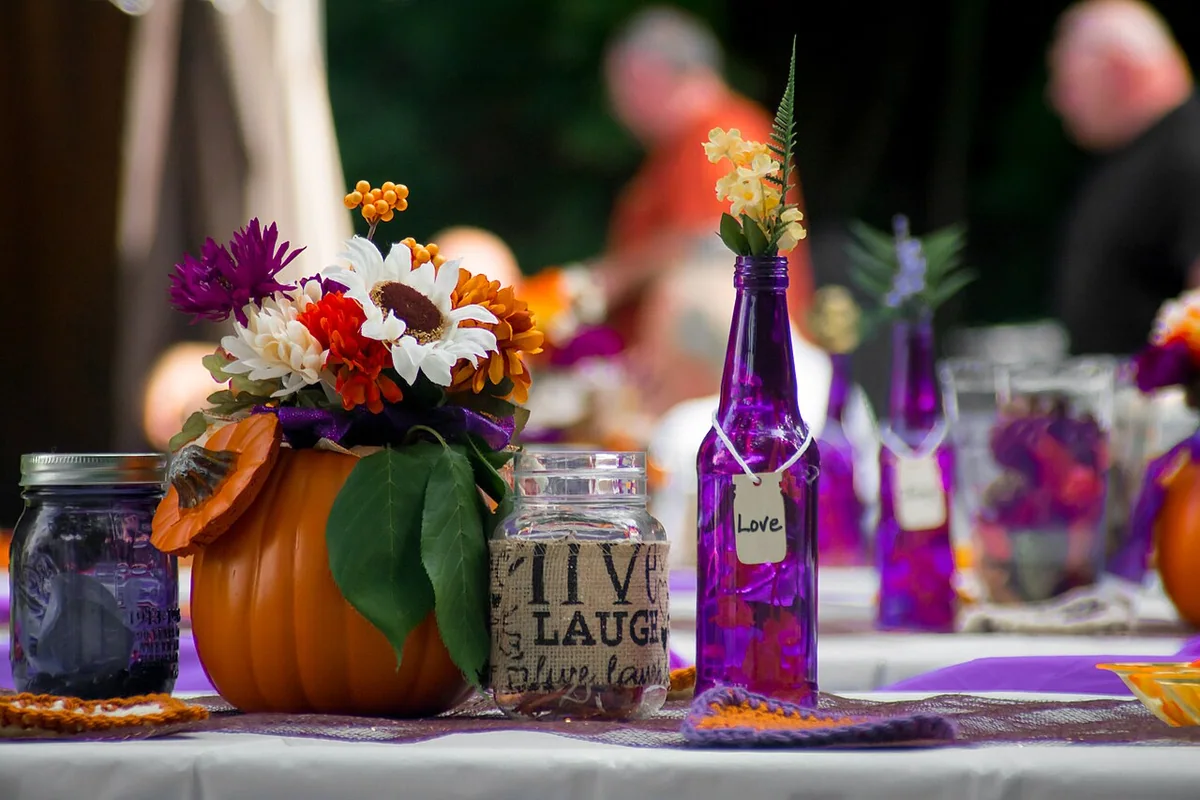
A pumpkin floral arrangement surrounded by candles and purple table details. Photo: Jess Mann, Table decorations during reception.jpg, CC BY-SA 4.0. Resized and converted to WebP; the image remains available under its original licence. This is an illustrative photograph, not a Vowlinora case study or a photograph of the worked example.
