
“I want something lightweight” is a useful starting preference, but a fabric name alone cannot tell you whether a complete gown will deliver it. Linings, layered skirts, embroidery, support structures and trims all contribute to the garment you wear. Compare the finished construction as well as the outer material.
Maggie Sottero’s fabric guide distinguishes materials used for different textures and shapes, including tulle, lace, chiffon, organza and crepe. Use those descriptions as vocabulary for a boutique conversation, not as promises that every gown bearing a label will behave identically.
🧵 Ask what the dress is made of
Request the specific gown’s fibre information, lining details and care instructions where available. Satin describes a weave or surface construction rather than one universal fibre. A sales description such as silky or airy is not a substitute for the product information.
- Identify the outer material and its fibre composition where confirmed.
- Ask how many layers and which support components are present.
- Try the complete dress rather than relying only on a swatch.
- Compare surface texture against your skin during comfortable movement.
- Ask about care, packing and alteration implications.
- Record unresolved questions before making the purchase decision.
Do not pull, rub or stretch a sample fabric to test it without the boutique’s permission. Ask the stylist to explain its intended behaviour and point out which parts of the sample may have changed through repeated use.
A worked comparison
Assume an illustrative shopper choosing between a gown with a smooth satin outer layer and a gown with a layered tulle skirt. Their priority is comfortable seated dining followed by dancing. The question is not which material is better, but which particular construction meets those activities.
| Question | Satin-surface gown | Layered-tulle gown |
|---|---|---|
| What creates the shape? | Ask about lining and internal support | Ask about number and type of layers |
| What touches the skin? | Inspect actual lining and seams | Inspect actual lining and seam finishes |
| How does it move? | Try sitting and turning | Try sitting and turning |
| What happens during travel? | Obtain gown-specific packing advice | Obtain gown-specific packing advice |
In this hypothetical exercise, the tulle dress could be heavier than expected because of its construction, while the smooth dress might move more freely than its photograph suggests. The reverse is also possible. Only the actual garments provide useful comparison evidence.
Separate appearance from comfort
Look at texture in ordinary light as well as under boutique spotlights. A reflective finish may emphasise folds differently from a matte one, but that is an aesthetic observation rather than a rule about which body should wear it.
Notice where embellishments or seam edges contact arms and torso. Ask whether a different lining or finish is available and whether it is part of the manufacturer’s options or a separate alteration. Do not assume that removing a layer is simple; it can affect opacity, shape and the intended construction.
For weather comfort, consider the complete outfit and schedule, including undergarments and accessories. Avoid treating silk, polyester, sleeves or a named fabric as a universal guarantee of coolness or warmth. Personal comfort and the event environment vary.
Include care in the shortlist
Ask how the specific dress should be stored, supported and prepared before wear. Decorative finishes and mixed materials can limit otherwise familiar care methods. Follow the actual label and manufacturer guidance rather than using a general online steaming or cleaning recipe.
Keep a photograph of the product information with your fitting notes. If the boutique cannot confirm a consequential detail, ask who can provide it and when, especially before ordering a non-returnable or customised gown.
The useful takeaway is a shortlist based on complete garments: the look you enjoy, the construction you can move in and a care plan appropriate to the actual dress.
Sources and further reading
Photograph credit
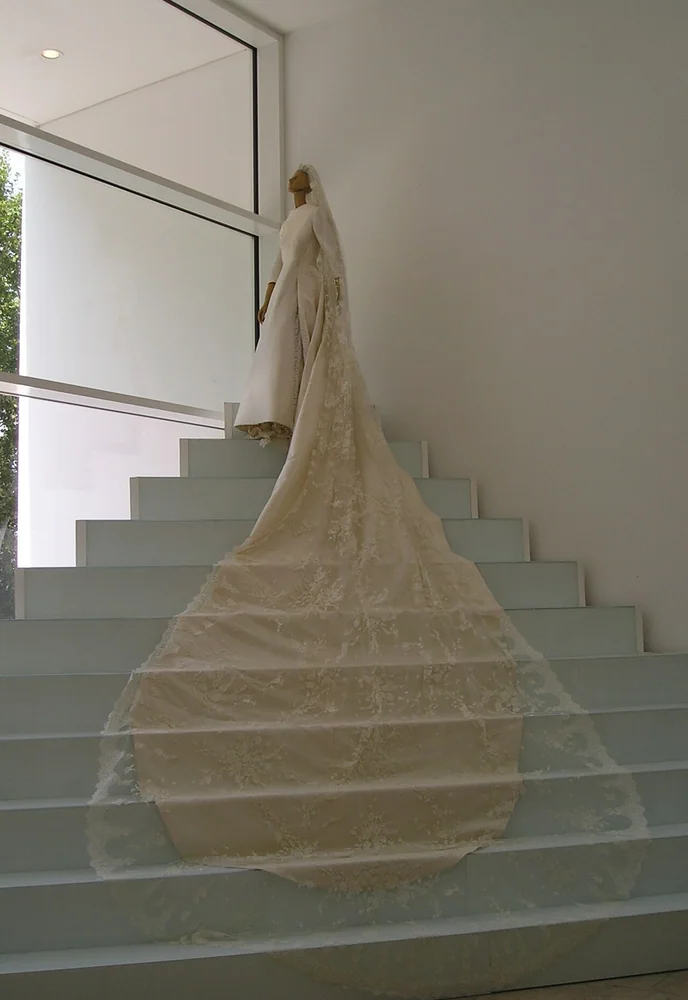
A Valentino wedding dress with a long train displayed on steps. Photo: Loquax, Valentino wedding dress.jpg, CC BY 3.0. Resized and converted to WebP; the image remains available under its original licence. This is an illustrative photograph, not a Vowlinora case study or a photograph of the worked example.
