Choosing between flowers and non-floral centrepieces is not simply a choice between expensive and inexpensive, or wasteful and sustainable. Either option can involve substantial materials, labour, transport and aftercare. Compare the complete plan rather than the label.
Start by describing the effect you want at the table: colour, softness, sculptural shape, personal meaning or a quiet background to dinner. Flowers may provide that effect directly. A group of ceramics, paper objects or other approved materials may suit it differently. Neither needs to imitate the other.
🌼 Compare practical demands
BRIDES recommends prioritising the elements that matter instead of assuming every optional detail is necessary. For centrepieces, that means comparing the job each option performs and the work it creates. Ask suppliers for costs and handling requirements specific to your proposed design.
- Describe the desired table effect in a few words.
- Confirm table size and service requirements with the venue.
- Request a floral option and a genuinely suitable alternative.
- Compare delivery, placement, removal and ownership.
- Test a representative arrangement from seated positions.
- Choose the option whose complete workload fits the event.
Do not assume a non-floral object is suitable for a dining table merely because it looks decorative. Check stability, clean handling, surface protection and whether it interferes with food service. Any flame or electrical element needs separate venue approval and appropriate supplier input.
A worked six-table comparison
Assume an illustrative reception with six dining tables. Option A is one florist-supplied arrangement per table, with vessels collected afterwards. Option B is a group of three hired ceramic objects per table. These are hypothetical designs, not quotations or claims about typical practice.
| Question | Floral option | Ceramic option |
|---|---|---|
| Objects to allocate | 6 arrangements | 18 individual objects |
| Handling information needed | Supplier’s display and care instructions | Supplier’s packing and surface instructions |
| After-event route | Agreed arrangement destination; vessels returned | All hired objects counted and returned |
| Visual check | Density and sightlines | Grouping footprint and sightlines |
Three objects on each of six tables means 18 objects to receive, place and recount. That does not make the ceramic option worse, but it changes the inventory work. The floral option also needs a clear plan for vessels and any arrangements someone intends to take home.
Ask better material questions
For flowers, discuss availability, acceptable substitutions, display conditions and the supplier’s care instructions. Do not infer exact colour or lasting quality from an edited photograph. Avoid making medical claims about fragrance or allergies; invite guests to discuss relevant needs privately and seek appropriate advice where necessary.
For non-floral materials, ask what the objects are made from, whether they are hired or purchased and how they should be cleaned or packed. A reusable object is useful only if there is a realistic next use or return route.
Environmental comparisons need more evidence than the words natural, artificial or reusable. Production, shipping, maintenance and disposal can all affect the result. This worksheet cannot establish a lifecycle ranking, so it deliberately avoids declaring one category universally greener.
Make the table test decisive
Set out the intended plates, glassware and shared dishes alongside each sample. Check conversation across the table and space for service. The HSE’s site-design guidance addresses audience activities and circulation at venue level; the relevant practical habit here is to design decoration around use rather than the other way round.
Choose the simplest version that delivers the effect you value. A hybrid arrangement may work, but combining flowers and objects also combines handling tasks. It is not automatically the economical compromise.
The useful takeaway is a decision based on the whole event: the table experience, the supplier’s actual scope and what happens to every component afterwards.
Sources and further reading
Photograph credit
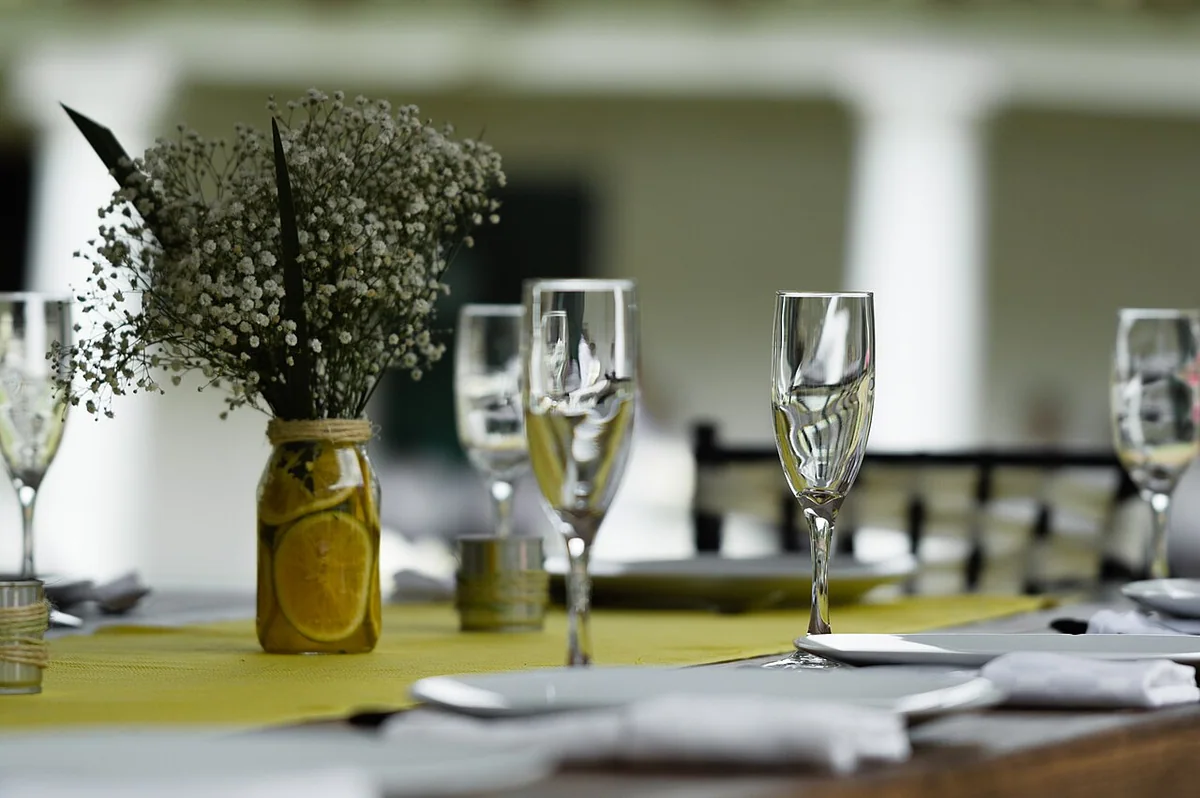
Small flowers in a glass bottle on a simply decorated dining table. Photo: Luis Ezcurdia, Simple Arrangements (224989469).jpeg, CC BY-SA 3.0. Resized and converted to WebP; the image remains available under its original licence. This is an illustrative photograph, not a Vowlinora case study or a photograph of the worked example.
