
A ceremony and reception do not need to share an address to feel connected. Equally, two beautiful locations can create an exhausting gap if the movement between them is treated as somebody else’s problem. Decide by the transition: what guests do after the ceremony, how they travel, and what they find when they arrive. This keeps the discussion focused on experience rather than a universal rule about convenience.
🧭 Describe the middle of the day
Write a short account of an ordinary guest’s journey from their ceremony seat to their reception seat. Include collecting belongings, finding transport, using toilets, waiting, and entering the second venue. Then write the same account for someone who cannot walk far or needs communication support. The second version often reveals assumptions that the first version misses.
W3C’s accessible-events guidance highlights accessible routes and facilities, along with information that helps participants understand them. HSE’s site-design guidance similarly treats access and circulation as practical design concerns. Neither source says every wedding must occupy one site. They support examining the complete journey instead of evaluating attractive rooms in isolation.
Compare the transitions, not only the buildings
| Question | One site | Two sites |
|---|---|---|
| What changes after the ceremony? | Possibly a room reset or walk | A departure and a new arrival |
| Where can guests rest? | Check available space during reset | Check both departure and arrival points |
| What must be communicated? | Room and route instructions | Addresses, transport, and arrival instructions |
| What could interrupt access? | Shared corridors or furniture movement | Traffic, vehicle suitability, or parking |
One-site celebrations also need scrutiny. A property may require guests to leave the only sheltered room while staff transform it. A hilltop ceremony and dining barn may share an address but involve a challenging route. Ask what happens between activities rather than assuming that a single postcode eliminates movement, waiting, or access barriers.
An illustrative two-site decision
Assume a couple wants a ceremony in a place with personal significance and a reception in a nearby restaurant. They expect 48 guests. The drive is short, but the ceremony site has limited waiting space and the restaurant cannot admit guests until its agreed opening. If guests leave immediately, they may arrive before the reception is ready. These are fictional conditions, not claims about any actual venue.
The couple asks both operators whether a comfortable transition is possible. They confirm a suitable place to wait, a usable drop-off at each site, and a simple arrival message. They also ask a transport provider about the required vehicles. If those pieces cannot be confirmed, they will keep the meaningful ceremony location for a private visit instead of forcing an unsuitable guest journey.
Give each transfer a clear owner
- Identify who confirms the ceremony has finished and guests may leave.
- Ask each venue who remains available if someone needs assistance or retrieves a forgotten item.
- Confirm where vehicles collect and unload without blocking other users.
- Make the second venue’s readiness a verified arrangement, not an assumption.
- Prepare an alternative communication method if mobile reception is unreliable.
Do not make guests responsible for transporting fragile decorations or shared equipment unless they have explicitly agreed and the task is appropriate. A reception team waiting for a ceremony microphone or important document can create an avoidable dependency. Ask suppliers what needs to move and whether the same item genuinely has to serve both locations.
The limits are local and personal: traffic, terrain, weather, religious requirements, and venue operations differ. A meaningful setting may justify a more involved transfer, but only when guests receive workable support and accurate information. Choose one site when it offers the better complete experience; choose two when the connection between them has been designed as carefully as the moments on either side.
Sources and further reading
Photograph credit
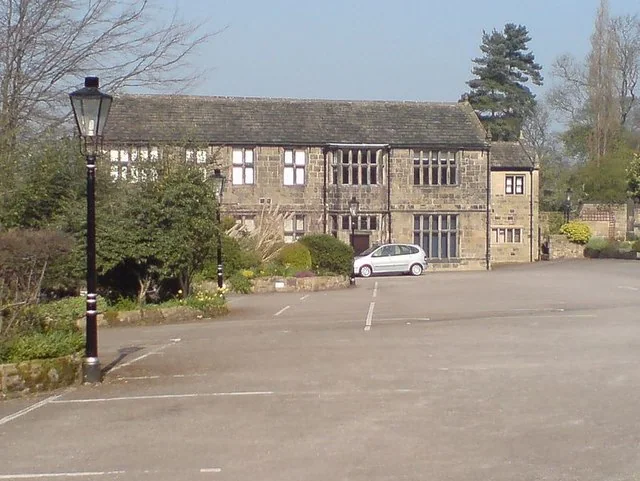
The stone exterior and grounds of Low Hall in Horsforth. Photo: RichTea, Low Hall, Horsforth – geograph.org.uk – 406170.jpg, CC BY-SA 2.0. Resized and converted to WebP; the image remains available under its original licence. This is an illustrative photograph, not a Vowlinora case study or a photograph of the worked example.
