A flower described as ‘in season in June’ is missing several important details: where it was grown, how it was grown and where your wedding takes place. Climate, hemisphere, cultivar and production methods can change availability. A global wedding calendar cannot promise what a particular florist will be able to buy.
Start with your event location and date, then ask the florist about their actual supply network. Do they buy from nearby growers, regional wholesalers, imports or a combination? What is reasonably expected, what remains uncertain and when will those expectations be reviewed?
🌿 Define what seasonal means to you
| Your priority | Useful question | Possible compromise |
|---|---|---|
| Nearby growing | What geographic area counts as local in this proposal? | More flexibility on species |
| A particular flower | How reliable is its supply for this location and date? | Different source or a substitute |
| A colour and texture | Which available materials create this effect? | Fewer named varieties |
| Lower waste | How do ordering, mechanics and end-of-event plans work? | Different arrangement scale or materials |
Do not assume local automatically means cheaper, and do not claim a lower environmental footprint without evidence about growing, transport, storage and materials. Local sourcing can be a meaningful preference without turning it into an unsupported sustainability ranking.
A fictional availability-led brief
Assume, illustratively, that a couple marrying in a cool coastal region wants soft pink flowers and airy foliage. Their inspiration board contains a named flower from a wedding photographed in a different hemisphere. Rather than demanding that exact variety, they tell the florist which qualities matter: loose movement, muted colour and a garden-like outline.
The florist is asked to propose one expected palette from their normal suppliers and a fallback that preserves the same visual priorities. The couple marks one sentimental flower as a request, not an unconditional promise. If its availability becomes uncertain, the approval process is already clear.
The Royal Horticultural Society’s cut-flower growing guidance describes how site, weather, plant selection and cultivation affect production. Its seasonal examples are useful horticultural context, but they are not an international wedding-supply guarantee. A florist’s live sourcing information is the more relevant guide to your actual order.
Turn uncertainty into a sequence
- Give the florist the date, location and intended installation conditions.
- Describe the visual priorities separately from named flower preferences.
- Ask which materials are expected and which are provisional.
- Agree what ‘local’ means if it is part of the brief.
- Approve a substitution framework and any price-change process.
- Schedule a practical availability review before final ordering.
- Let the florist confirm the final selection close enough to purchase to be useful.
Ask what happens if weather or supply disruption affects the expected flowers. The answer should cover both communication and money: who chooses the substitute, whether approval is needed and what happens if the alternative changes the cost. Silence should not be treated as permission for a materially different design.
Keep quality separate from a flower name
A requested species does not tell you everything about condition, maturity or durability. Chrysal’s professional guidance explains that growing conditions, post-harvest handling and transport influence vase life. Ask the florist how the selected materials suit your ceremony, photographs and reception conditions rather than assuming a seasonal label ensures performance.
If you are considering homegrown contributions, discuss quantities, cutting windows and backup supply with the florist early. A garden can contribute meaningful materials, but a weather-dependent harvest should not be represented as a guaranteed production order. Do not collect plants from land without permission or ignore local conservation restrictions.
The takeaway is to buy a well-defined floral effect with honest sourcing expectations. A flexible brief can respect place and season while leaving room for the living materials to vary.
Sources and further reading
Photograph credit
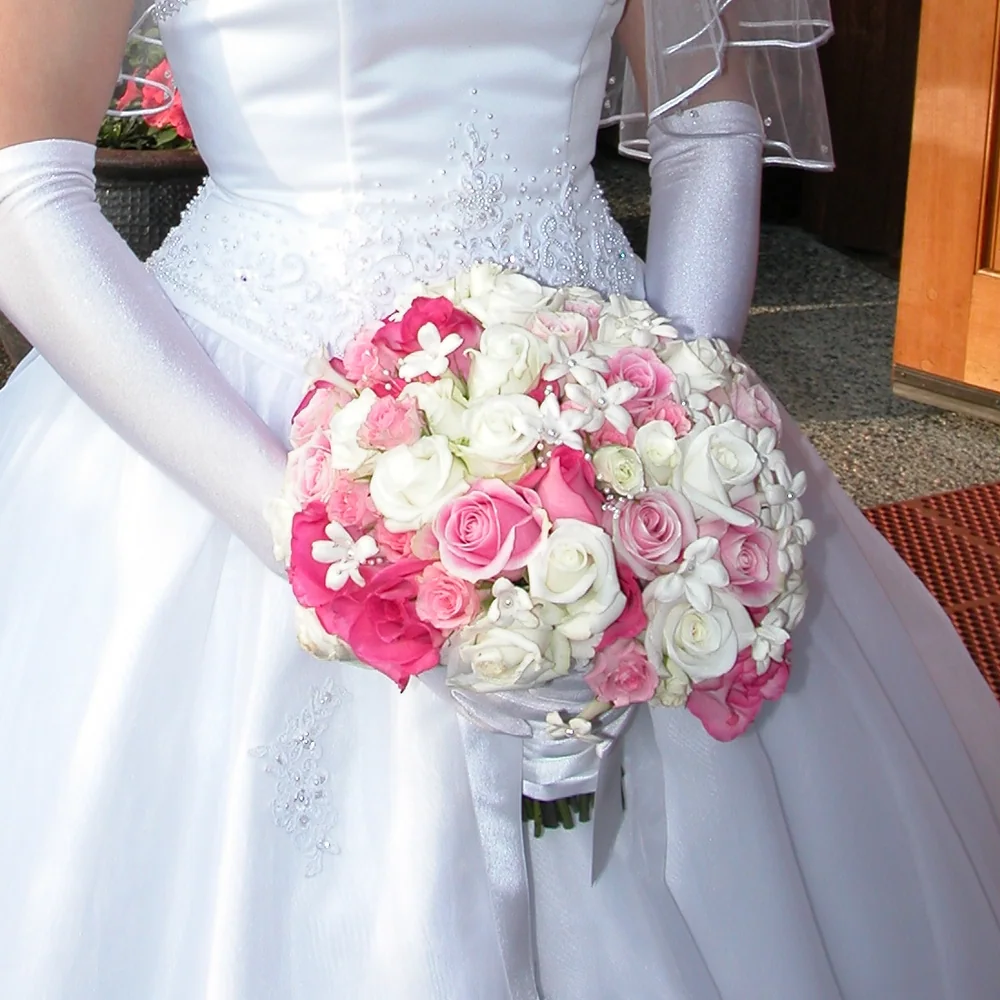
A white and pink bridal bouquet held against a wedding dress. Photo: Photo by and (c)2007 Jina Lee, Bridal bouquet white pink rose stephanotis.jpg, CC BY-SA 3.0. Resized and converted to WebP; the image remains available under its original licence. This is an illustrative photograph, not a Vowlinora case study or a photograph of the worked example.
