
A beverage plan is more than a bottle count. It needs comfortable access to water, appealing alcohol-free choices, enough glassware and a service team able to replenish supplies. Start there rather than assuming an alcoholic drink for every guest at every stage of the celebration.
People may avoid alcohol for health, religious, financial, recovery, driving or personal reasons, and they do not owe the couple an explanation. Make alcohol-free options visible and ordinary. If you serve alcohol, agree lawful service and age-verification arrangements with the licensed provider under the rules that apply locally.
🥤 Separate demand from stock
| Worksheet line | What to estimate | What the supplier must confirm |
|---|---|---|
| Water | Access points and refill demand | Supply, service vessels and replenishment |
| Alcohol-free drinks | Options and intended serving occasions | Ingredients, availability and preparation capacity |
| Alcohol, if offered | Optional demand by guest preference | Local rules, service limits and responsible operation |
| Ice and chilling | Service and storage requirements | Equipment, handling and delivery |
| Glassware | Simultaneous use and replacement | Washing, collection and breakage terms |
A litre total cannot tell you whether guests can actually get a drink. One distant water station may be less useful than table service or several reachable refill points. Discuss routes and queues with the venue, including access for guests who cannot comfortably carry a full glass.
A service-stage stock and replenishment worksheet
Assume a fictional 60-person reception budgets two 250-millilitre alcohol-free welcome servings per person. That gives 120 servings and 30 litres of prepared drink. For dinner and a later service period, the couple models one 200-millilitre alcohol-free serving per person at each stage: 60 servings and 12 litres per stage. These are chosen purchasing assumptions, not predictions, targets for guests or adequate hydration allowances.
| Stage | Prepared-drink calculation | Owner and release check |
|---|---|---|
| Welcome | 60 × 2 × 0.25 L = 30 L | Bar lead confirms ready stock and reachable serving points |
| Dinner | 60 × 1 × 0.20 L = 12 L | Service captain confirms glassware, refills and clearing |
| Later period | 60 × 1 × 0.20 L = 12 L | Bar lead checks demand before releasing later stock |
| Separate chosen reserve | 6 L; amount agreed only for this scenario | Named lead monitors stock and may release within agreed authority |
| Water throughout | Separate supplier-confirmed supply and refill plan | Venue/caterer confirms access, capacity and replenishment responsibility |
Initial prepared drinks total 54 litres; adding the separate six-litre reserve makes 60 litres of planned prepared stock. Water is not included in either number. Do not label 60 litres “enough for the wedding”: duration, weather, preferences, losses and actual demand require the provider’s assessment. Nobody is expected to consume the modelled servings.
If the welcome drink is supplied in containers holding five usable litres, the initial welcome allocation requires six containers. That does not specify the containers for later drinks, usable dispenser capacity, recipes or chilling arrangements. Ask the provider to confirm those separately; prepared-drink volume is not automatically the volume of syrup or concentrate to buy.
For your real worksheet, add supplier-confirmed storage/chilling, glassware and washing, refill trigger, reserve location, authorised purchaser and unopened-stock terms to each row. A trigger might be the provider’s agreed minimum remaining stock, not an invented universal quantity. When it is reached, the named lead checks serviceable reserve and approval before ordering more.
Confirm water supply and accessible service before approving the optional-drink order. Have the provider describe how water remains available during transitions and who notices an empty station. Keep any food handling, ice, storage and preparation decisions with the catering team; this worksheet allocates responsibility rather than prescribing preservation methods.
Turn the worksheet into a service plan
- Map the celebration’s drinking occasions without assuming alcohol at any of them.
- Ask guests only for preference information that changes purchasing decisions.
- Agree an initial quantity and a separate replenishment plan with the provider.
- Confirm water access throughout the event.
- Check glassware, washing, ice, chilling and staffing as distinct requirements.
- Agree what happens to unopened stock and who can authorise more.
Cater Directly’s catering guide includes glassware, staffing, equipment and venue time in a complete cost comparison. That is relevant to drinks too: an apparently simple self-service bar can still create delivery, washing, clearing and staffing costs.
Ingredients and service need their own checks
Alcohol-free does not mean suitable for every dietary requirement. Ask the supplier about ingredients in syrups, garnishes, milks, mixers and prepared drinks, and how questions will be answered. In the United Kingdom, official food-business allergy guidance emphasises accurate information and updates when ingredients change. Other jurisdictions have their own requirements.
Do not make wellness claims for a signature drink or promise that it is universally safe. If a guest needs a specific product or ingredient check, connect them with the provider. Keep any beverage preparation or storage decisions with the catering team rather than improvising preservation methods.
The takeaway is to plan choice and access before calculating bottles. Use quantities as transparent assumptions to review with the provider, not as rules about what guests should consume or what constitutes enough for everyone.
Sources and further reading
Photograph credit
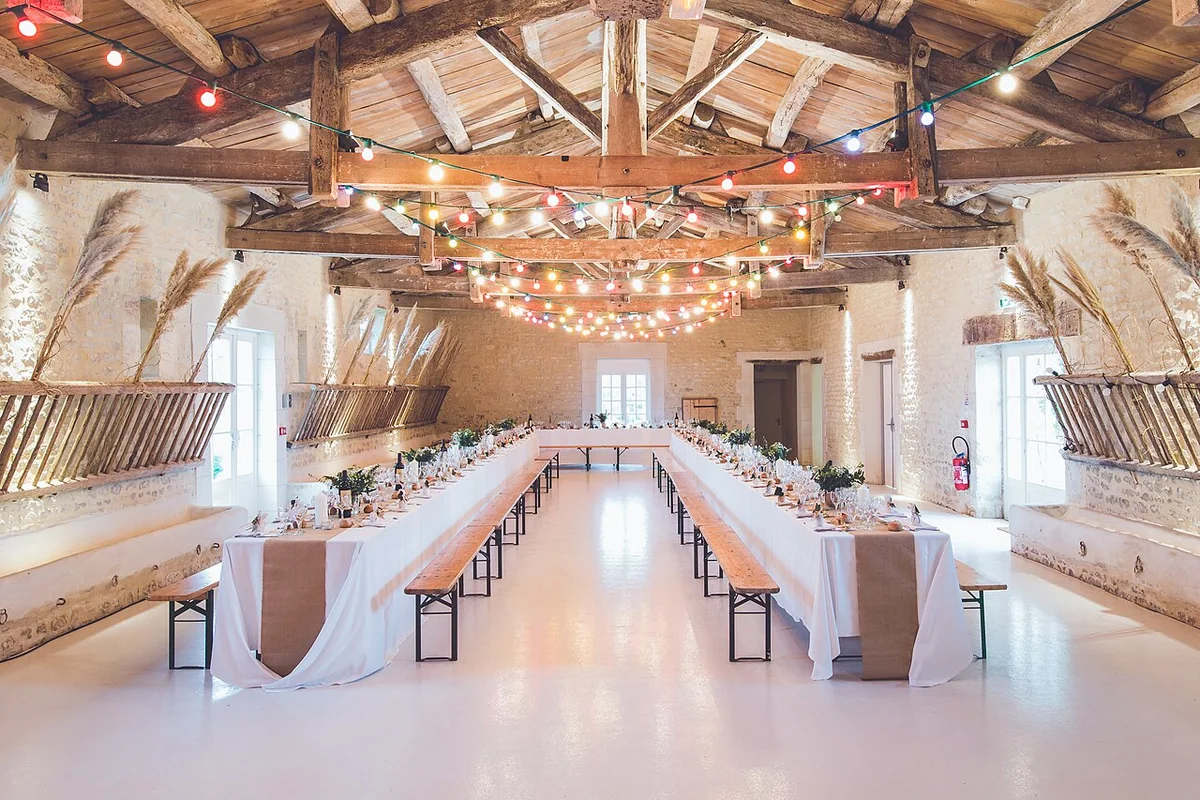
Long reception tables and benches inside a decorated rustic hall. Photo: Sweet Ice Cream Photography sweeticecreamphotography, Wedding reception tables and benches (Unsplash).jpg, CC0. Resized and converted to WebP; the image remains available under its original licence. This is an illustrative photograph, not a Vowlinora case study or a photograph of the worked example.
