
A note reading ‘special meal’ is not a catering plan. It does not explain what a guest needs, whether the kitchen can meet it or how the right plate will reach the right person. The couple’s most useful role is to create an accurate communication chain without acting as the food-safety authority.
Separate the collection of a request from its confirmation. An RSVP field records what someone tells you. It does not establish that a menu, ingredient supplier or preparation environment is suitable. The caterer needs enough time to discuss ingredients and cross-contact controls before anyone promises a solution.
📝 Record the need without interpreting it
| Information | Who should clarify it | Planning action |
|---|---|---|
| Guest’s stated requirement | Guest or responsible adult | Record their wording accurately |
| Ingredients and preparation | Caterer | Confirm what can be provided |
| Seating and meal identification | Planner and service captain | Connect the agreed meal to the person |
| Last-minute ingredient change | Caterer | Recheck suitability before service |
| Private contact route | Guest and named organiser | Keep sensitive discussion out of public lists |
Ask guests to identify allergies, intolerances and other dietary requirements in their own terms, with a private contact option. Do not downgrade an allergy to a preference or assume a religious requirement has one universal interpretation. Equally, do not ask for a medical history when a practical food discussion is sufficient.
A worked communication example
Assume an illustrative wedding has three distinct requests: one guest reports a sesame allergy, one asks for a vegan meal and one requests food prepared according to particular religious requirements. These are three conversations, not one category called ‘alternative.’ The vegan meal may contain sesame; a menu description alone cannot resolve the allergy request.
The organiser forwards each request, with the guest’s permission and relevant contact details, to the caterer’s named coordinator. The caterer explains available options and limitations directly. The organiser records whether the discussion is pending or confirmed, the agreed meal identifier and any service instructions needed by the captain.
If the kitchen cannot meet a request, the answer should be communicated early and honestly. Discuss workable alternatives with the guest and venue rather than improvising an outside meal on the day. Any outside-food arrangement needs agreement about storage, handling, service and responsibility.
Make the handoff operational
- Ask the caterer for its dietary-information deadline and preferred process.
- Collect requests privately and preserve the guest’s exact meaning.
- Arrange direct clarification for consequential or ambiguous requirements.
- Record the caterer’s confirmation and any limitations.
- Connect confirmed meals to the final seating and service plan.
- Reconcile changes before issuing the final version.
- Identify the staff member guests should approach during service.
For England, Wales and Northern Ireland, FSA guidance covers allergen information and handling practices. GOV.UK’s food-business guidance emphasises accurate information, updates when recipes or ingredients change and delivery to the correct customer. These jurisdiction-scoped obligations should inform the supplier’s process, not be presented as universal international law.
Avoid promises the menu cannot support
Do not call a wedding ‘allergen-free’ because the planned dishes omit one ingredient. Ingredient sourcing, preparation and service can affect suitability. Do not use ‘hypoallergenic menu’ or imply that a dietary symbol proves the absence of cross-contact. The caterer should provide the relevant information and determine appropriate controls.
Keep public seating charts and place cards discreet. A coded service marker can be useful if the caterer has a clear key, but it should not reveal a guest’s private circumstances unnecessarily. Avoid ambiguous homemade symbols that staff must guess under pressure.
The takeaway is that good hospitality combines accurate information with honest limits. Ask early, hand off clearly and let qualified catering staff confirm the food and service arrangements rather than allowing a well-meant RSVP note to become an unsupported promise.
Sources and further reading
Photograph credit
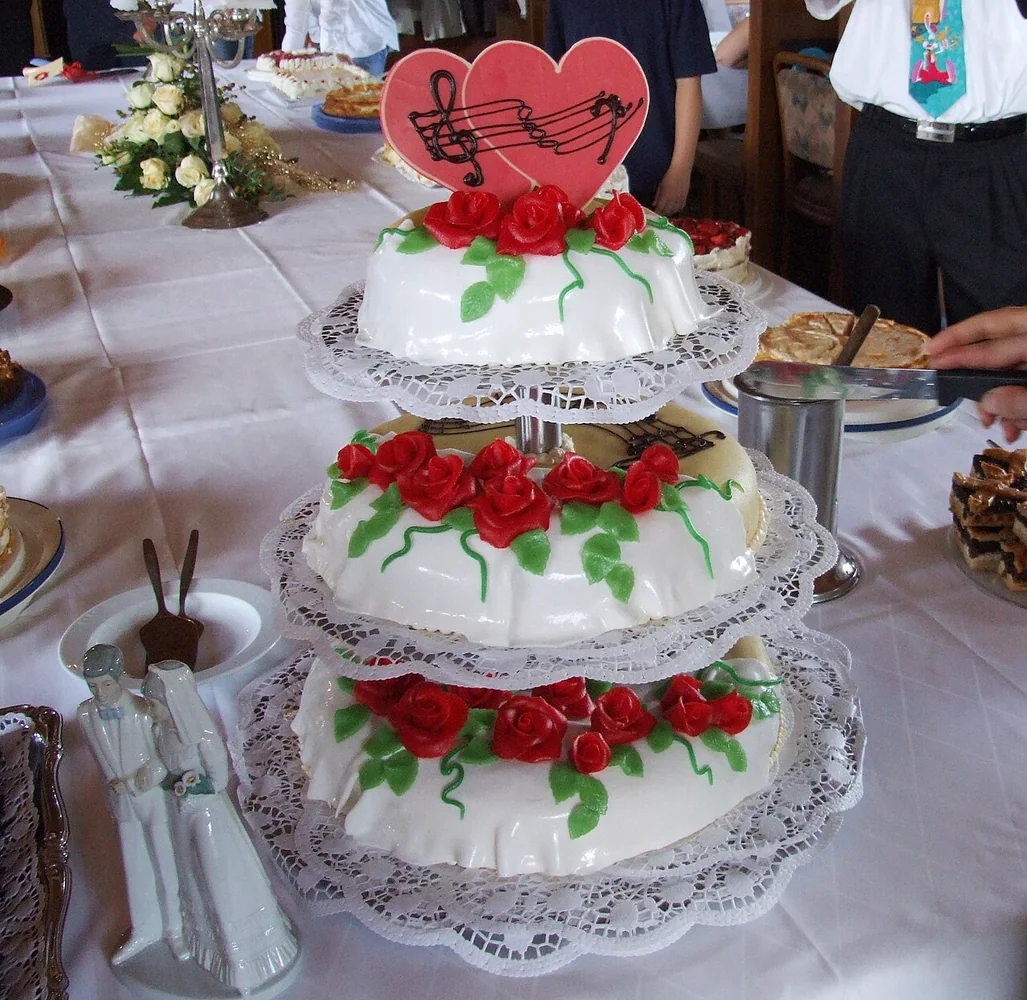
A tiered white wedding cake decorated with red and green details. Photo: Claus Ableiter, Hochzeitstorte.jpg, CC BY-SA 3.0. Resized and converted to WebP; the image remains available under its original licence. This is an illustrative photograph, not a Vowlinora case study or a photograph of the worked example.
