A wedding suite can change postal category after the final ribbon, liner or seal is added. That is why a postage estimate based on an empty envelope is unreliable. The object you need assessed is the sealed, fully assembled mailing in its intended form.
Postal rules are jurisdiction-specific and can change. Start with the operator in the country from which you will post, then check requirements for each destination and service. Guidance for a domestic United States letter should not be applied automatically to international mail or to another country’s postal system.
📮 Build one real mailing sample
Use the actual paper stocks, all inserts, the intended envelope and any embellishment. If a sample is not yet available, ask the stationer for a physical prototype rather than relying solely on a digital mock-up. Include a return envelope or response card if those will be mailed with the suite.
| Check | What to bring or ask | Why it matters |
|---|---|---|
| Weight | The completed sample | Extra inserts can change the required postage |
| Shape and dimensions | Actual envelope, not catalogue dimensions alone | Square or unusual formats may be classified differently |
| Thickness and flexibility | Sealed suite with decorations | Lumps or rigidity can affect processing |
| Destination | Domestic and international address groups | Services and address requirements differ |
| Return response | Reply method and origin countries | Outbound postage does not solve return postage |
USPS domestic guidance explains that letter pricing depends on more than weight: envelopes need to meet shape and size conditions, and rigidity, lumps or certain closures can make an item nonmachinable or change its classification. The practical lesson is to request an assessment of your sample. Do not assume one ordinary stamp covers a decorated suite.
An illustrative design decision
Imagine a fictional couple choosing between a rectangular flat suite and a square suite with a raised seal. They have 40 domestic mailings and 12 international mailings. Before approving the second design, they take both assembled samples to their local postal operator and ask which services and postage apply to each destination group.
No price is assumed in this example. The comparison worksheet records the operator’s current quotation, date checked, service and any handling condition. If the embellished version changes category, the couple can compare the total mailing cost and reliability considerations before ordering rather than discovering the difference after addressing every envelope.
They also ask whether the seal needs protection or a different construction. A request for special handling is not a guarantee that an item will avoid all automated equipment or damage. If an embellishment is essential, ask the stationer and operator what protective format is appropriate.
Complete the postal check in order
- Separate destination countries and confirm current recipient addresses.
- Assemble the exact suite and measure or weigh it only as a preliminary check.
- Ask the originating postal operator to confirm classification and service options.
- Check address placement, return address and any destination-specific conventions.
- Verify how international guests can return an RSVP if you use paper replies.
- Buy postage only after the design and assessment are settled.
- Keep a dated note of the advice and recheck if the suite changes.
Allow for variability between assembled pieces. A different insert or extra card can make one group heavier than another. Label assembly batches so the right postage goes on the right suite, especially when language editions or transport inserts differ.
Know what the check cannot promise
A correct postage assessment does not guarantee delivery by a particular date unless the chosen service explicitly offers relevant terms, and even then conditions matter. Weather, address errors and cross-border handling can disrupt plans. Avoid making major travel decisions depend on a single piece of untracked mail arriving promptly.
The takeaway is simple: design, assemble, assess, then buy postage. A short conversation about the actual mailing can protect both your stationery budget and the guest’s chance of receiving a readable invitation.
Sources and further reading
Photograph credit
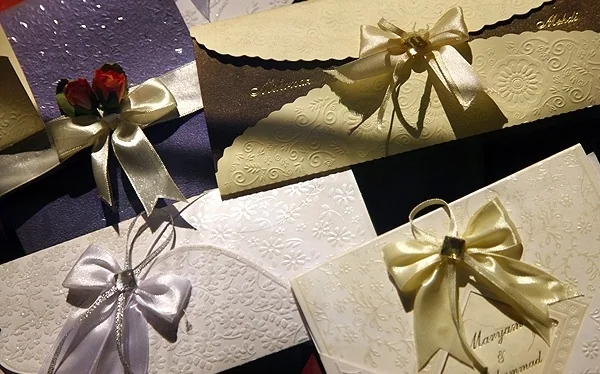
Decorative invitation boxes finished with large satin bows. Photo: Mohammad Hassanzadeh, Invitation card shops in Tehran 04.jpg, CC BY 4.0. Resized and converted to WebP; the image remains available under its original licence. This is an illustrative photograph, not a Vowlinora case study or a photograph of the worked example.
