A menu card is an invitation to enjoy dinner, not a complete ingredient specification. The challenge is to make it appealing without turning a short description into an unsupported promise. Words such as vegan, gluten-free or nut-free can carry practical consequences beyond their visual role on a printed page.
Write from the caterer’s approved menu, not a memory of the tasting or an inspiration photograph. Confirm the main ingredient, important accompaniments and any terms that matter to guests. If a sauce or garnish changes, the wording and dietary information may need to change too.
📝 Separate description from confirmation
| Wording issue | Better approach | Who approves |
|---|---|---|
| Long list of decorative adjectives | Name the dish and useful accompaniments | Couple and caterer |
| Unverified dietary label | Use only caterer-confirmed terminology | Caterer |
| Claim of universal suitability | Invite individual ingredient discussion | Caterer |
| Unfamiliar culinary term | Add a brief plain-language explanation | Caterer |
| Changing seasonal component | Agree a substitution and update process | Caterer and organiser |
In England, Wales and Northern Ireland, FSA allergen guidance is an official reference for relevant food businesses. GOV.UK guidance highlights accurate allergen information, updates when recipes change and staff processes for answering questions. Those requirements should not be reduced to a decorative symbol on the couple’s stationery.
A fictional menu edit
Assume an illustrative main course was initially described as ‘Garden vegetable tart with herb sauce.’ The couple wants to label it vegan because it contains no visible meat. The caterer explains that the pastry and sauce must be checked before that description is approved. The couple removes the unconfirmed label and asks for the final recipe information.
After the caterer confirms the agreed dish and its service arrangements, the printed description can be updated accordingly. If a guest has an allergy, that guest still needs accurate ingredient and cross-contact information from the catering team. A plant-based description does not answer every allergy question.
For this imaginary menu, the couple also changes ‘velouté’ to a short explanation the caterer approves. The purpose is comprehension, not stripping away a cuisine’s identity. Keep dish names respectful and accurate, and do not invent a cultural origin or authenticity claim to make a course sound more interesting.
Approve wording in a defined sequence
- Obtain the current written menu from the caterer.
- Draft concise descriptions using confirmed ingredients.
- Ask the caterer to approve dietary terms, symbols and explanatory notes.
- Check readability at the actual printed size.
- Confirm how guests will access current ingredient information.
- Lock the print version and agree how later changes are communicated.
A possible note, subject to the caterer’s approval, is: ‘For ingredient and allergen information, please speak to the catering team.’ That note is a route to information, not a substitute for whatever disclosure and handling processes the business must provide locally.
Understand the limits of symbols
If you use icons, include a clear legend and avoid relying on colour alone. A leaf could mean vegetarian, vegan, local or simply decorative unless it is defined. Homemade initials can also create ambiguity across languages. Use plain words where a symbol would require explanation.
Do not print ‘allergen-free menu’ or ‘safe for everyone.’ A menu cannot establish suitability for every guest and every possible ingredient concern. Avoid ‘may contain’ wording invented by the couple as a blanket disclaimer; ask the caterer how accurate precautionary information should be presented under applicable guidance.
Late changes require active communication. If a substitution affects a confirmed dietary arrangement, the service team should resolve it with the guest before the meal is served. A small corrected menu card alone is not an adequate handoff.
The takeaway is to let the menu describe and the caterer confirm. Clear, attractive wording works best when it stays connected to current recipes, trained staff and a reliable way for guests to ask questions.
Sources and further reading
Photograph credit
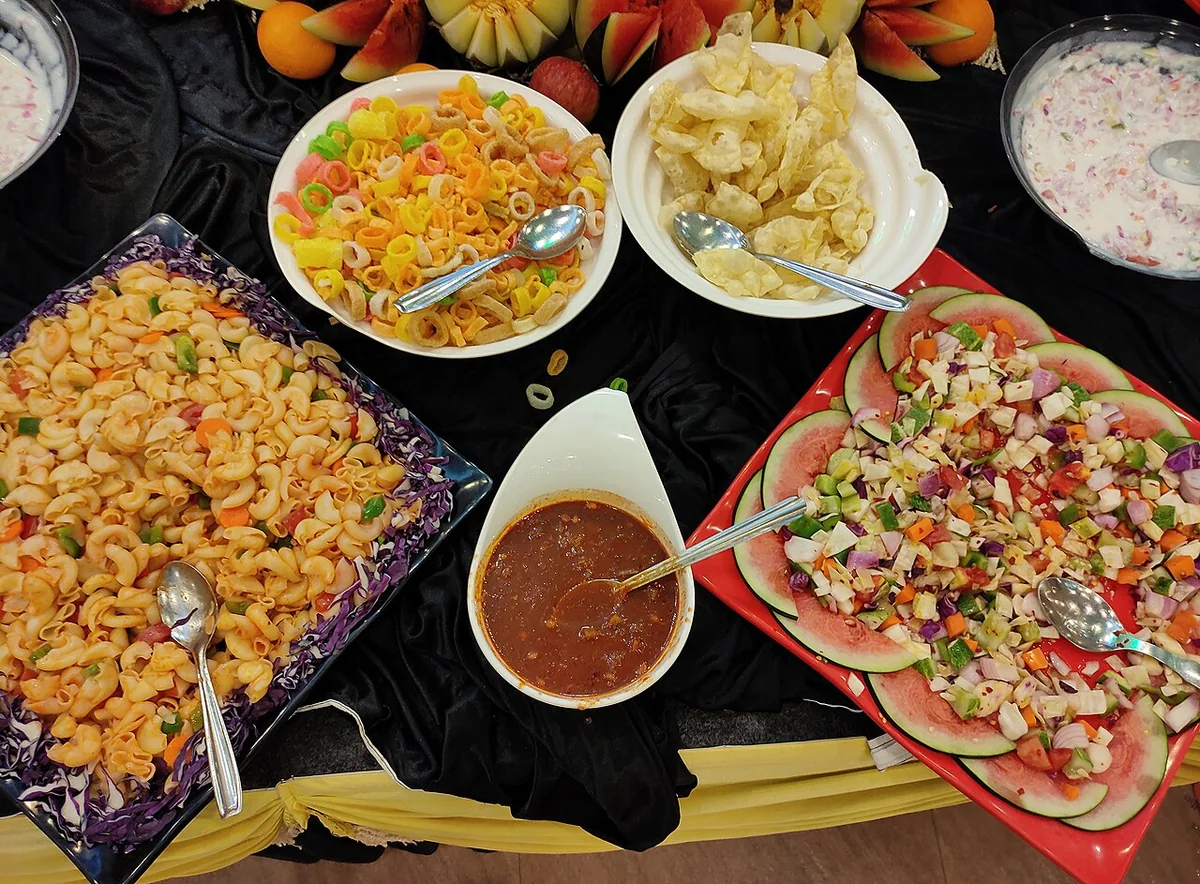
Several prepared salads arranged together on a reception buffet. Photo: Vis M, Salads at a Wedding Reception, Kochi, Kerala 01.jpg, CC BY-SA 4.0. Resized and converted to WebP; the image remains available under its original licence. This is an illustrative photograph, not a Vowlinora case study or a photograph of the worked example.
