
A useful rehearsal does not require everyone to perform the ceremony from beginning to end. It needs to answer the moments that could otherwise cause confusion: where people wait, who gives a cue, how a transition happens and what changes if someone cannot attend.
Begin with your actual ceremony plan and the person authorised to lead it. Different venues, celebrants and legal settings have different requirements. This schedule addresses movement and communication only; it does not prescribe religious practice, cultural order or the legal elements of a marriage.
🎶 Rehearse the uncertain parts
Wedding Planner Central places the rehearsal among final preparations and recommends confirming ceremony music cues. Turn those broad tasks into a short session whose length fits your venue access. Confirm that the room, relevant equipment and key people will actually be available.
- Obtain the approved ceremony outline and identify movement or audio transitions.
- Ask participants about access needs and any movements they do not want to perform.
- Assign one cue-giver and agree how the cue will be communicated.
- Walk through the uncertain transitions slowly.
- Repeat only the points that need another attempt.
- Send a concise cue sheet to absent participants and relevant suppliers.
Do not require people to memorise exact step counts. The actual pace will change with clothing, mobility, emotion and the room. A visible cue and a clear destination are more robust than an elaborate timing trick.
A worked 35-minute session
Assume an illustrative non-denominational ceremony with two entrances, a reading and a departure. The venue has agreed to a 35-minute rehearsal window, and the celebrant has approved the outline. These timings are a planning example, not a required ceremony order.
| Minutes | Task | What must be resolved |
|---|---|---|
| 0–5 | Briefing and positions | Names, waiting points and cue-giver |
| 5–15 | Entrances and seating | Comfortable route and clear destination |
| 15–23 | Reading transition | Microphone handover and return route |
| 23–30 | Departure | Who moves first and where people go |
| 30–35 | Questions and recap | Changes captured in cue sheet |
If the microphone is unavailable, mark the audio check as unresolved rather than pretending it has been tested. Arrange a separate check with the supplier. If furniture differs from the wedding layout, identify which routes must be reviewed again when the final arrangement is in place.
Build the cue sheet
Use four columns: moment, cue-giver, cue and action. For example: “Reading transition; celebrant; introduces reader by name; reader moves to the agreed position.” Keep private personal details out of the circulated version.
For music, agree the track version, start point and who signals the operator. An entrance plan that depends on a precise musical moment should have a simpler fallback. Ask the operator how they prefer cues rather than assuming a gesture will be visible from their position.
Give substitutes a role, not an imitation. If someone cannot attend the rehearsal, a stand-in can help test spacing, but the real participant still needs their own clear instructions. Confirm whether any mobility aid or support person changes the route, with the participant’s involvement.
Also confirm where participants go after leaving the ceremony space. A beautifully rehearsed exit can still lead to a blocked doorway if everyone stops immediately outside. Ask the venue for an appropriate gathering point and communicate it without directing people into vehicle routes or restricted service areas.
Finish with decisions, not more rehearsal
Record the final waiting locations, cue-giver and unresolved checks. Send only the information each participant needs. Avoid introducing a new procession order in a casual message after everyone has learned the approved one.
A rehearsal cannot reproduce weather, guest movement or the emotional pace of the day. Its takeaway is practical confidence rather than theatrical precision: each person knows their next action, what triggers it and whom to ask if something changes.
Sources and further reading
Photograph credit
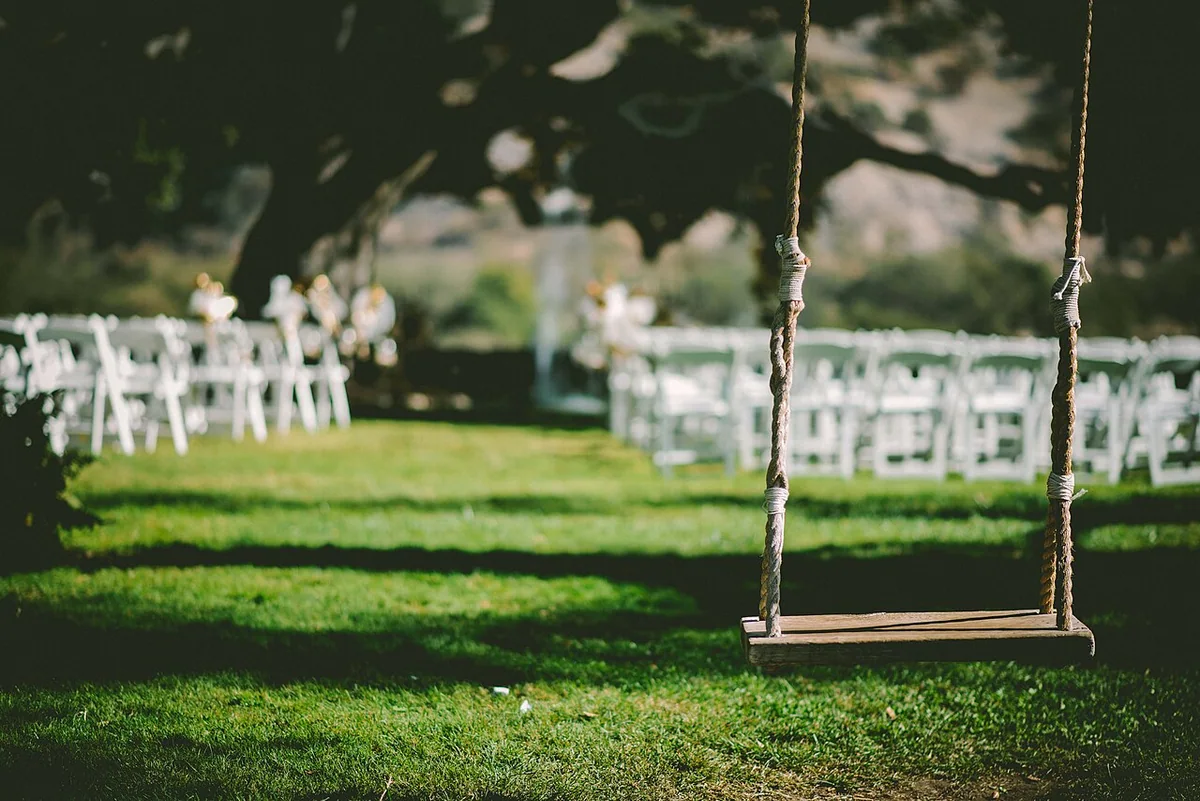
A wooden swing beside an outdoor reception with white chairs. Photo: Ben Rosett spiritvisionstudios, Wooden swing at wedding venue (Unsplash).jpg, CC0. Resized and converted to WebP; the image remains available under its original licence. This is an illustrative photograph, not a Vowlinora case study or a photograph of the worked example.
