A table arrangement can look balanced in an overhead photograph and still interrupt dinner. The vase may sit exactly between two faces, or a generous cluster of objects may leave no comfortable place for shared dishes. Test the complete table as a working surface before multiplying the design.
The Health and Safety Executive’s venue-design guidance considers the audience, activities and circulation when assessing a site. At table level, the same planning habit is useful: decoration belongs within a layout that people can use. The venue and caterer should confirm service and access requirements for the actual event.
🌿 Build one real place setting
Use the intended table shape and dimensions where possible. Add chairs, linen, plates, glasses, cutlery, menus, water and any shared food items. A centrepiece tested on an empty table is missing most of its competition for space.
- Ask the venue which table and chair combinations are available.
- Confirm the caterer’s service style and tabletop requirements.
- Place a representative centrepiece in the proposed position.
- Sit at several seats and check views across and along the table.
- Practise reaching the items guests need without moving the decoration.
- Photograph the approved arrangement and record its actual components.
Do not use a universal height rule as a substitute for this check. A narrow, open structure and a dense arrangement can block views differently even at the same height. Guests also sit at different heights, so test more than one viewpoint.
A worked shared-dining table
Assume an illustrative rectangular table intended for eight guests. The caterer needs a clear central zone for shared dishes. Your initial design uses three floral vessels and two decorative objects. In the hypothetical mockup, the objects occupy the same space required for the serving platters.
| Element | Problem to check | Adjustment to discuss |
|---|---|---|
| Central floral vessel | Blocks view between opposite seats | Change shape or position; retest seated |
| Two decorative objects | Compete with shared dishes | Remove rather than crowd the table |
| Table number | Hidden behind glassware | Use an approved visible position |
| Water bottles | No stable landing space | Reserve a specific service area |
Removing objects is not an aesthetic failure. In this example, keeping one carefully positioned arrangement may make the table feel more intentional than squeezing in every original component. The final choice depends on the real table and service plan.
Check edges and movement
Look at what happens when someone pulls out a chair, places a bag nearby or receives a plate. Runners, trailing foliage and hanging details should not create avoidable interference. Ask the venue before using attachments or materials that could mark furniture.
Test the arrangement from the seat of anyone whose specific access requirements you know, with their involvement where appropriate. Do not assume one wheelchair position or one chair type represents every guest. The approved room layout needs usable routes as well as attractive tables.
If candles are proposed, obtain the venue’s rules and use only arrangements it approves. This article does not provide flame-clearance or installation instructions. Battery-operated alternatives also need appropriate placement and handling; they are not permission to clutter a route or service area.
Turn the mockup into instructions
Record quantities by table type, because a design that fits a long table may not translate to a round one. Note what is intentionally absent so a well-meaning helper does not fill the clear service space with spare decor.
Include a simpler fallback for a table that changes size or position. The coordinator should know which optional object can be omitted without needing a new styling discussion during setup.
A mockup cannot reproduce every guest movement or service moment. Its useful takeaway is a table designed from the seated experience outward: conversation remains possible, service has space and decoration supports the meal rather than competing with it.
Sources and further reading
Photograph credit
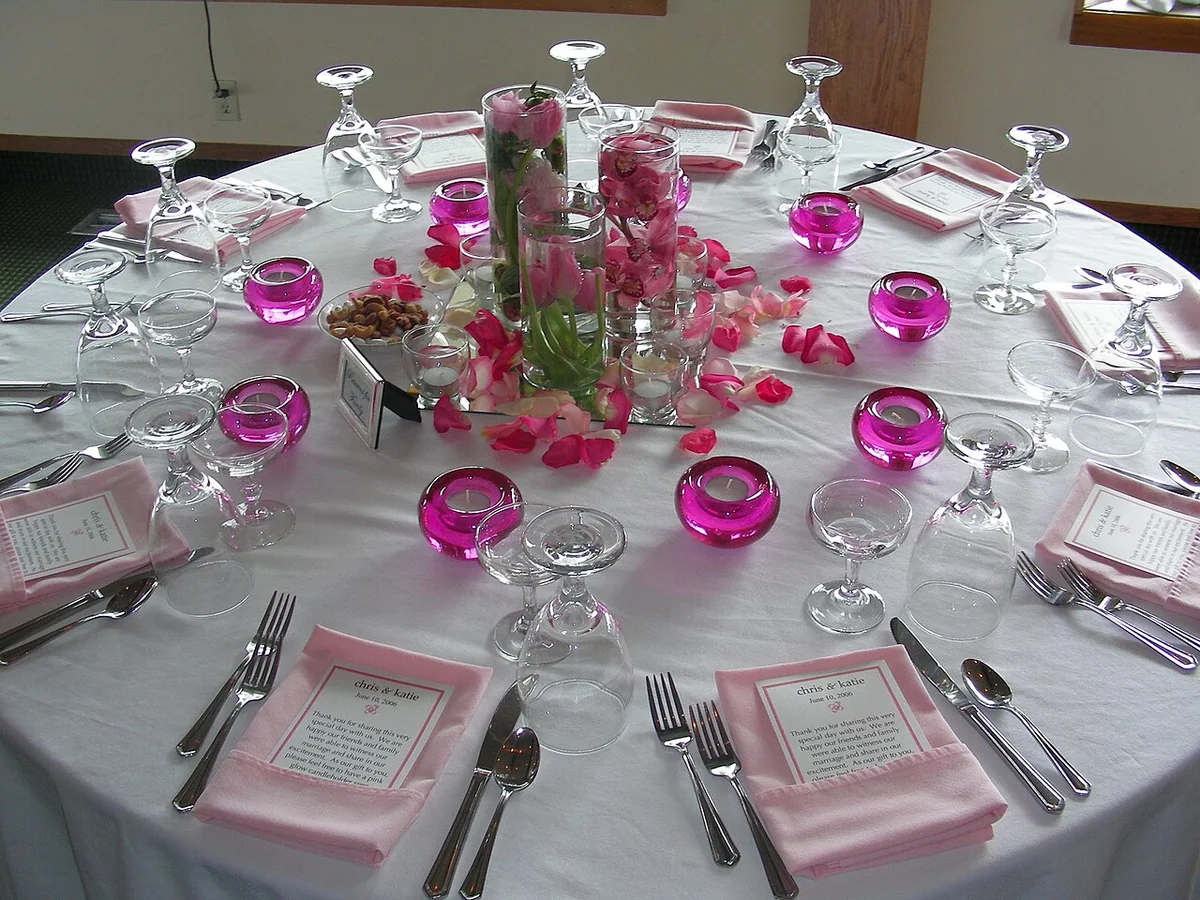
A pink and white reception table with flowers and place settings. Photo: Tracy Hunter, Wedding Banquet setting.jpeg, CC BY 2.0. Resized and converted to WebP; the image remains available under its original licence. This is an illustrative photograph, not a Vowlinora case study or a photograph of the worked example.
