The decision between digital and printed invitations is easier when it stops being a competition between modern and traditional. Both can work beautifully, and both can fail. A printed suite sent to an outdated address is not more reliable than an unopened email; an elegant animation is not useful if a guest cannot read its event details.
Choose the format by examining your guests, the information and your capacity to manage responses. You may discover that a hybrid approach solves more problems than a single format. The aim is one coherent invitation experience, not identical objects delivered to every household.
📬 Compare the tasks, not the aesthetic
| Planning need | Print consideration | Digital consideration |
|---|---|---|
| Reliable access | Requires a usable postal or hand-delivery address | Requires a channel the recipient actually uses |
| Changing details | Corrections need a separate message | Updates can be fast but may go unnoticed |
| Readable information | Test actual paper size and contrast | Test devices, keyboard access and text alternatives |
| Privacy | Manage address lists and discarded proofs | Check tracking, sharing and platform settings |
| Keepsake value | A physical object is immediately available | A printable or saved version may help |
Do not make age the deciding factor for someone else’s preference. Ask what works. A younger guest may want paper, while an older relative may respond most comfortably by email. Accessibility needs also vary within each group.
A deliberately mixed example
For an illustrative wedding with 50 invitation groups, assume 30 prefer digital delivery, 15 prefer post and five will receive invitations in person. The couple chooses a printed main card for the 20 physical deliveries and the same factual content in a simple digital message for the other 30. All groups receive the same response deadline and event description.
The response database uses one identifier per invitation group, regardless of delivery method. If a posted guest replies by telephone, the organiser records that answer in the master list. Sending a reminder does not create another guest entry. These assumptions illustrate an administrative structure, not a recommended percentage split.
The couple also keeps essential directions in the message itself. A digital invitation that contains only a large image can make text difficult to enlarge or interpret with assistive technology. A QR code on paper should have an accompanying readable web address and an alternative contact route.
Make the response route accessible
W3C’s forms guidance recommends requesting only necessary information, using clear labels and providing understandable feedback. Apply those principles whether a guest reaches the form from paper or a phone message. Avoid forcing an account registration unless the chosen system genuinely requires it and you have provided an alternative.
For digital delivery, send individual messages or use a platform that does not expose the guest list. Check whether tracking features are necessary and whether recipients can forward sensitive details. A delivery or open indicator is not an RSVP, and it should not be treated as proof that someone understood the invitation.
Choose and implement in order
- Ask households which delivery route they can use comfortably.
- Write a single approved factual master for all formats.
- Test the printed size and the digital reading experience.
- Set up one response register with clear ownership.
- Send a small test to trusted recipients before the full release.
- Record returned mail or failed digital delivery and follow up personally.
Costs need a complete comparison. Print may involve envelopes, finishing and postage; digital may involve subscriptions, custom design or platform limitations. Environmental comparisons also depend on materials, quantities, travel and digital systems. Without a defined assessment, neither format deserves an automatic sustainability label.
The strongest choice is the one your guests can receive, understand and answer. Keep the factual content consistent, make alternatives ordinary rather than exceptional and let the delivery format serve the celebration instead of becoming its own project.
Sources and further reading
Photograph credit
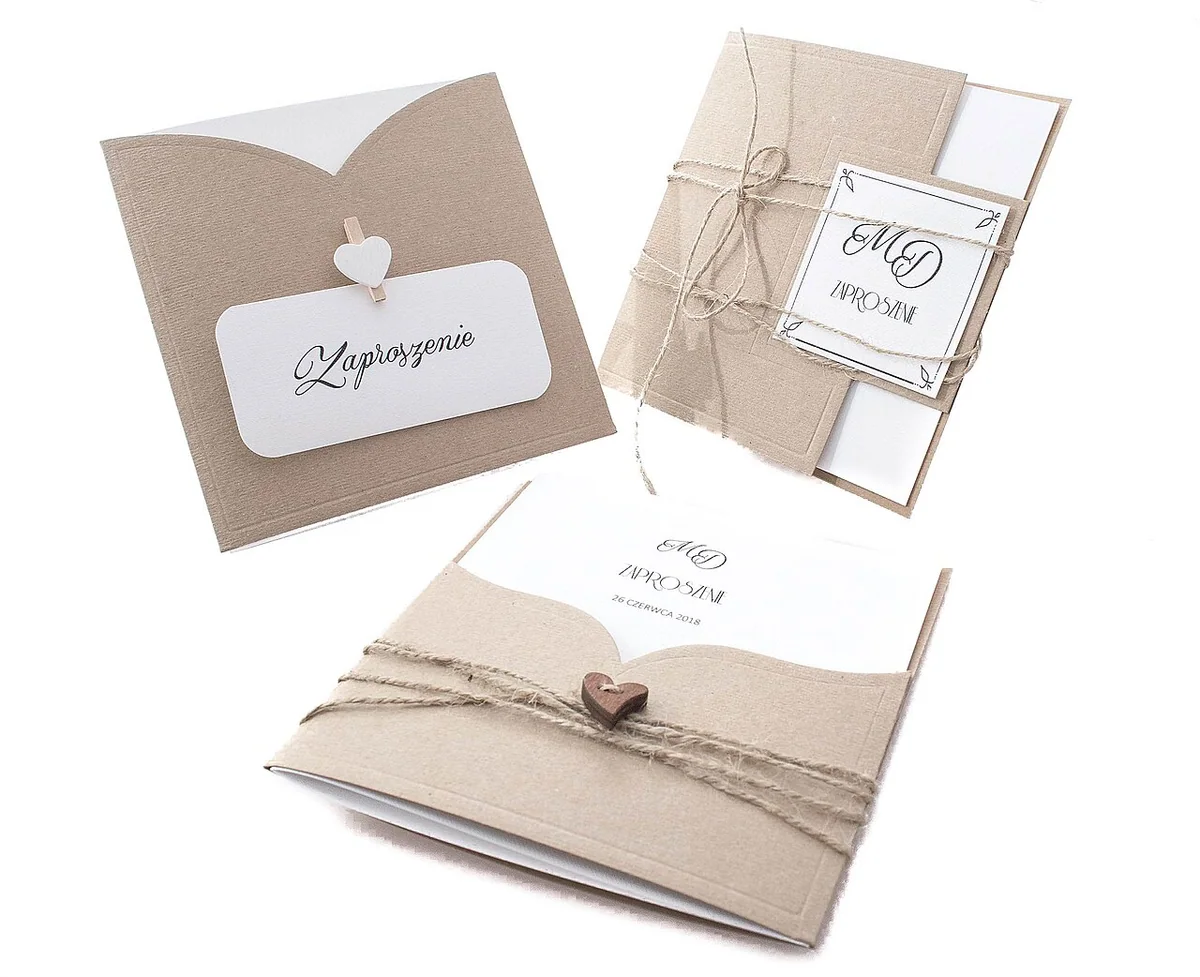
A coordinated invitation suite with a heart motif and a ribbon. Photo: Ezaproszeniaslubne, Wedding Invitations.jpg, CC BY-SA 4.0. Resized and converted to WebP; the image remains available under its original licence. This is an illustrative photograph, not a Vowlinora case study or a photograph of the worked example.
