
A guest count is not an invitation quantity. Two people may share one mailing, while two adults at the same address may appropriately receive separate invitations. The reliable unit is the invitation group you deliberately create, not a guessed ratio of guests to envelopes.
Begin with the guest list, then add a separate mailing-group column. A group can be a couple, a household or one person. Decide grouping according to the invitation’s actual recipients and their preferences rather than assuming everyone sharing an address should be treated as one social unit. Preserve individual names even when they share an envelope.
✉️ Build the mailing count from the bottom up
Assign a simple identifier to each invitation group. Then count unique identifiers for each event or suite version. Keep ceremony-and-reception invitations separate from celebration-only or other genuinely different invitations. Do not let a household label accidentally invite someone to an event they are not included in.
| Worksheet column | What it records | Why it matters |
|---|---|---|
| Person name | Each intended guest | Preserves the people count |
| Mailing group | One identifier per invitation | Creates the print quantity |
| Suite version | Events and language edition | Prevents wrong-card assembly |
| Delivery method | Post, hand delivery or digital | Separates print from postage needs |
| Address verified | Confirmation status | Flags unfinished administration |
Worked example with explicit assumptions
Suppose, purely for illustration, that a wedding has 86 invited people. The couple groups them into 29 two-person invitations, eight three-person household invitations and four individual invitations. The arithmetic is 58 plus 24 plus four people, giving 86 guests but only 41 invitation groups.
Assume three of those groups prefer a digital invitation. That leaves 38 printed suites. The couple chooses to order four additional suites for address mistakes, two for personal keepsakes and one for the photographer’s optional detail photographs. Under these assumptions, the order is 45 printed suites: 38 plus four plus two plus one.
Those spare quantities are choices, not an industry standard. A more expensive print process, a long reprint lead time or unusually complex addressing could change the decision. If the stationer sells only fixed batches, compare the cost and practical value of the next batch rather than pretending the exact calculated quantity is always available.
Count components separately
Forty-five main invitations do not automatically mean 45 of every insert. In this example, only 12 printed groups might need a shuttle card, while every printed group needs the general details card. Inner envelopes, outer envelopes, response cards and return envelopes each deserve their own quantity line. Count any addressing practice envelopes separately from complete spare suites.
Postal needs are another calculation. The United States Postal Service’s domestic guidance explains that envelope shape, thickness, flexibility and weight affect how mail is classified and charged. That does not determine your invitation count, but it explains why one fully assembled sample should be checked before buying postage for all mailings. Other countries have their own systems.
Turn the count into an order
- Freeze a dated guest-list version for the initial order.
- Assign and review invitation groups, keeping individual names visible.
- Separate language editions, event access and delivery methods.
- Calculate the base quantity of every printed component.
- Add deliberately chosen spares and record their purpose.
- Ask the stationer about batch sizes, overruns and reprint conditions.
- Reconcile delivered pieces before addressing begins.
Do not use spare invitations as a substitute for an agreed guest-list policy. If later invitations are possible, consider timing and guest experience thoughtfully rather than printing a hidden second list into the arithmetic. Likewise, a returned or declined invitation does not reduce the number already ordered or posted.
The useful takeaway is to maintain two totals throughout planning: invited people and invitation groups. When those numbers live in separate columns, ordering becomes a transparent calculation instead of a last-minute estimate.
Sources and further reading
Photograph credit
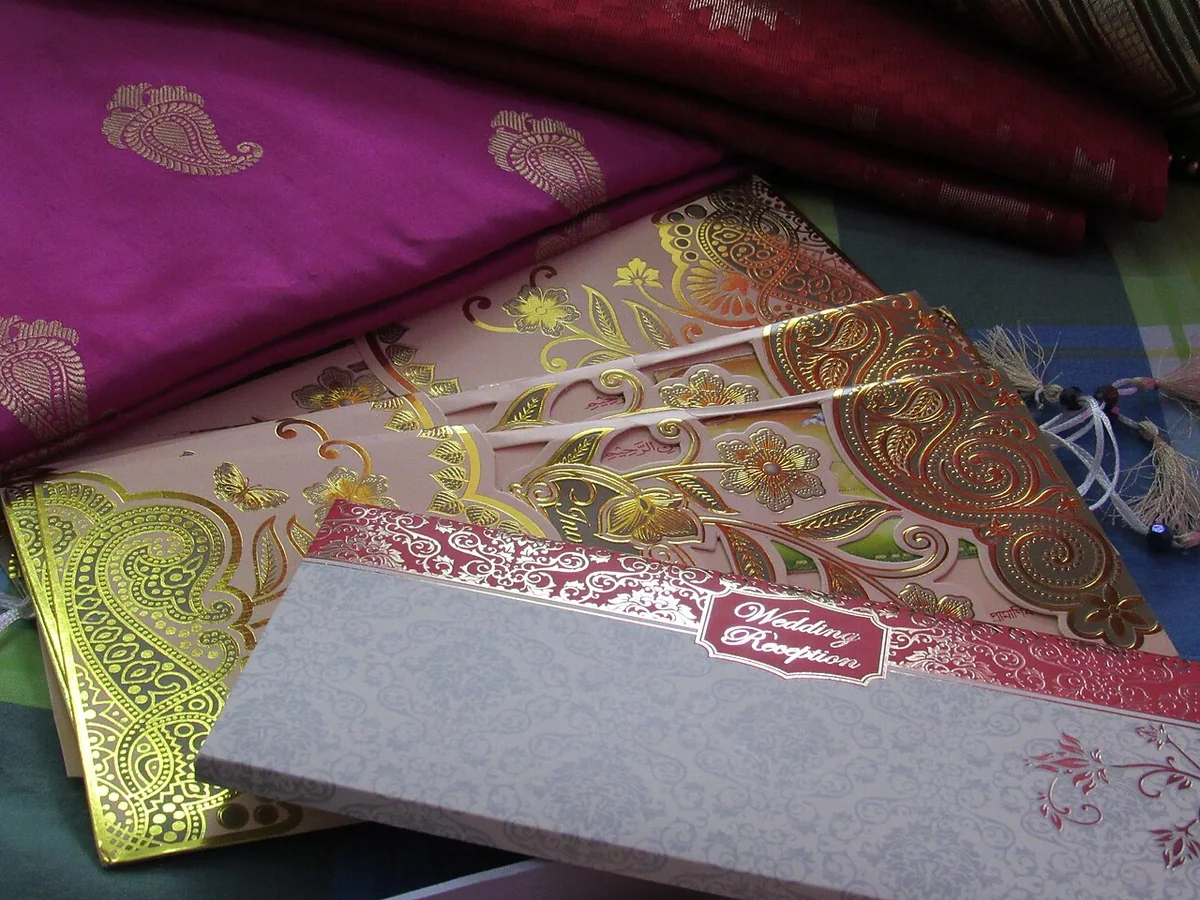
Colourful wedding invitation cards arranged beside folded saris. Photo: Afifa Afrin, Saris, wedding cards in a bed 01.jpg, CC BY-SA 3.0. Resized and converted to WebP; the image remains available under its original licence. This is an illustrative photograph, not a Vowlinora case study or a photograph of the worked example.
