
A details card should answer the questions that would otherwise become messages on the wedding morning. Where exactly should I arrive? At what time? Is there a transfer? Which parts of the celebration am I invited to attend? It is not a brochure for every idea still being discussed.
Begin with the route a guest will actually take. Someone travelling from another country may need a city and country, while a local guest may need the correct entrance to a familiar venue. Useful specificity is more valuable than a decorative map without an address.
🧭 Sort information by consequence
| Information tier | Examples | Best treatment |
|---|---|---|
| Essential to attending | Venue, address, date, arrival and start times | Readable text on the invitation or card |
| Essential to a particular group | Booked shuttle pickup or separate event | Clearly labelled insert for those recipients |
| Useful but changeable | Parking updates or detailed travel notes | Updateable page plus contact alternative |
| Optional inspiration | Local activities or sightseeing | Separate from attendance instructions |
Emily Post’s invitation guidance identifies the basic information invitations need even when wording is informal. A details card extends that practical purpose. It should not remove so much information from the main invitation that a guest holding only the principal card cannot identify the event.
Work through one fictional journey
Assume an illustrative celebration uses a ceremony room at one venue and dinner in another building. Guests should arrive at 14:30 for a 15:00 ceremony, and a booked transfer leaves at 16:15. The details card gives both venue addresses, identifies the ceremony entrance and says who may use the transfer.
The card might read: ‘Please arrive from 14:30; the ceremony begins at 15:00. Use the courtyard entrance on River Street. For guests with a confirmed shuttle place, departure to dinner is at 16:15 from the signed pickup point.’ The couple should replace all fictional details with venue-confirmed instructions, not guess walking times from a map screenshot.
If dinner starts at 17:00, distinguish that from transfer departure. Avoid a line such as ‘Reception 16:15’ when the actual meaning is ‘transport leaves.’ If guests must arrange their own travel between locations, say so plainly and provide the addresses without implying that a shared transfer exists.
Write the card in a useful sequence
- Confirm the schedule and location names with the responsible suppliers.
- List each guest decision: arrival, transport, access contact and response.
- Put the highest-consequence information first.
- Use labelled times instead of an unexplained column of numbers.
- Remove provisional plans or identify a clear update channel.
- Ask someone unfamiliar with the venue to describe their journey using only the card.
For international readers, spell out the month to reduce numeric-date ambiguity and include the year. If an online event or remote component is involved, specify the relevant time zone. For an in-person event, a clear local-time label may help guests who are still coordinating travel across zones.
Make access information practical
Invite private questions about access rather than assuming one general phrase covers every need. Ask the venue about step-free entrances, surfaces, toilets and transport arrangements before writing claims. A wheelchair symbol alone does not explain the route, and an organiser should not describe a venue as universally accessible without checking relevant details.
Digital supplements need the same clarity. W3C’s form guidance supports understandable labels and instructions for response tasks. If a website hosts shuttle reservations, make its questions simple and provide a contact alternative. A QR code should not be the only way to discover an essential address.
Keep a change log once the suite is released. If the entrance or pickup point changes, tell affected guests directly rather than expecting everyone to revisit a website. The takeaway is to organise the details card around the guest’s journey: accurate location, labelled time, clear transport promise and a human route for questions.
Sources and further reading
Photograph credit
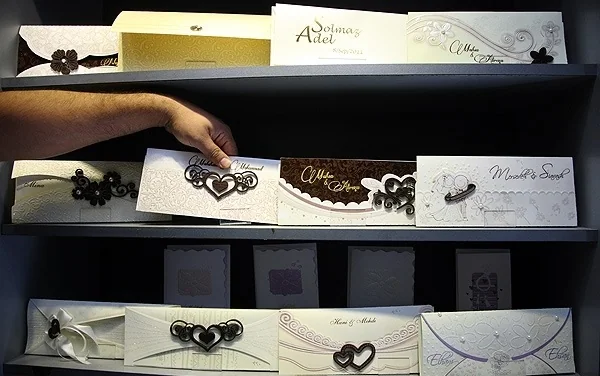
Physical invitation designs displayed on shelves in a Tehran card shop. Photo: Mohammad Hassanzadeh, Invitation card shops in Tehran 05.jpg, CC BY 4.0. Resized and converted to WebP; the image remains available under its original licence. This is an illustrative photograph, not a Vowlinora case study or a photograph of the worked example.
