A mood board can show a printer the atmosphere you like, but it cannot tell them how many pieces to make or what counts as an acceptable finished result. A production brief translates visual preferences into decisions that can be quoted, proofed and approved.
Write the brief before asking several suppliers for prices. Otherwise one may quote a main card only while another includes envelopes, assembly and a premium finishing process. A seemingly cheaper offer may simply describe a different product. You do not need technical expertise, but you do need to distinguish confirmed requirements from questions for the printer.
🖨️ Describe the finished object first
| Brief section | Information to supply | Question to resolve |
|---|---|---|
| Components | Main card, details card, envelopes and quantities | Are different versions priced separately? |
| Finished format | Trimmed dimensions and orientation | Will it fit the chosen envelope? |
| Material and finish | Desired feel, colour and reference sample | What stock and process achieve this? |
| Artwork | Who supplies and edits the file | What export specification is required? |
| Proofs | Digital, physical or process-specific proof | What can each proof actually demonstrate? |
| Delivery | Required date and delivery location | When must approval occur? |
Specify the finished size rather than relying on a name that may vary between countries or vendors. If you have not chosen a size, say so and ask the printer to propose an efficient format. Include postal testing as a decision point before approving unusual envelopes or heavy embellishments.
A worked brief with illustrative assumptions
Assume a fictional order needs 60 main cards, 60 details cards and 65 envelopes. The couple wants a warm-white uncoated appearance, dark text and a simple two-sided layout. They describe the intended effect and request a stock sample rather than declaring that an unfamiliar paper weight will necessarily feel substantial.
The brief states that the designer supplies artwork, the couple approves wording and the printer confirms file suitability. It asks for separate lines covering printing, envelope addressing, proofing, assembly and delivery. These quantities and specifications are illustrative, not a recommendation for every wedding.
For colour, the couple includes a physical reference and explains what matters most: readable dark text and a muted accent. They ask whether the proposed proof represents production colour on the chosen stock. A screen preview cannot establish the exact appearance of ink on textured paper, and a standard office printout cannot demonstrate every specialist process.
Agree the file handoff
Adobe’s InDesign guidance explains the role of crop, bleed and registration marks and tells users to confirm the marks their print provider expects. Use that principle rather than exporting every available option. Ask for the printer’s required PDF settings, bleed, font handling and image specifications. There is no single file recipe that overrides the provider’s workflow.
- List every component and confirmed quantity.
- Ask the printer to recommend suitable materials and processes.
- Compare itemised quotes against the same scope.
- Approve the final wording before preparing production artwork.
- Review the agreed proof and record any limitations.
- Give written approval for one clearly identified final file.
- Check the delivered order against the brief before assembly.
Record the terms that prevent surprises
Ask how corrections, reprints, overruns, shortages and damaged deliveries are handled. Confirm whether production time begins at deposit, artwork receipt or final approval. If the deadline is tight, clarify what happens when a proof needs another round rather than assuming the delivery date remains unchanged.
Do not assume a quoted paper, foil or specialist process will be available indefinitely. If substitutions are possible, require approval before material changes. Keep one person responsible for communicating revisions so a printer is not reconciling contradictory messages from several relatives.
The takeaway is to brief for decisions, not just aesthetics. A clear scope lets the printer advise intelligently, lets you compare like with like and makes the final approval a documented production step rather than a hopeful email.
Sources and further reading
Photograph credit
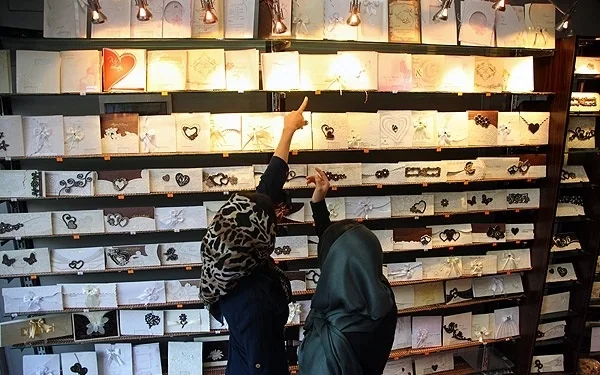
Shoppers viewing invitation designs displayed in a stationery shop. Photo: Mohammad Hassanzadeh, Invitation card shops in Tehran 07.jpg, CC BY 4.0. Resized and converted to WebP; the image remains available under its original licence. This is an illustrative photograph, not a Vowlinora case study or a photograph of the worked example.
