
Plated and buffet service are not simply formal and informal versions of the same dinner. They organise people, equipment and kitchen work differently. The right choice depends on what your venue and caterer can deliver together, not which label sounds more elegant or affordable.
A plated dinner moves meals to guests. A buffet moves many guests towards food. Both need trained staff, clearing, replenishment and a plan for dietary requirements. Cater Directly’s professional planning guide makes the useful point that neither format has an automatic cost or speed advantage once the full service model is considered.
🍽️ Follow the route of a plate
Walk through the proposed room with the caterer and venue representative. For plated service, ask where meals are assembled and how staff reach the furthest table. For a buffet, identify the queue, the return route, accessible circulation and the replenishment path. A food table that looks attractive on a floor plan may block the only useful route to the toilets.
| Question | Plated discussion | Buffet discussion |
|---|---|---|
| How do guests receive food? | Meal identification and coordinated delivery | Table release, queue management and assistance |
| What limits capacity? | Plating space and service routes | Serving frontage and replenishment |
| What must be known in advance? | Meal choices and seating positions | Numbers, dietary arrangements and layout |
| What is included? | Staff, tabletop and clearing | Attendants, equipment, clearing and power |
An illustrative room comparison
Assume a fictional reception has 72 guests seated at nine tables of eight. The room has one narrow doorway between kitchen and dining area. The caterer proposes either a plated menu with a defined service team or a staffed buffet along a side wall. Those are planning assumptions, not tested capacities.
For the buffet proposal, the couple asks the team to demonstrate where a waiting group stands without obstructing the doorway. For the plated proposal, they ask how dirty plates return while main courses are leaving the kitchen. The same bottleneck matters in different ways. Adding a second buffet line is not helpful if it merely doubles traffic through the same pinch point.
The couple also asks how a guest who cannot comfortably carry a plate will be served. Assistance should be planned and discreet, not improvised by expecting a companion to manage everything. If the room cannot support comfortable circulation, the service label needs reconsidering.
Compare complete offers
- Give both options the same guest count, menu scope and meal period.
- Ask for staffing roles and hours, including setup and clearing.
- List equipment, crockery, glassware, power and kitchen requirements.
- Agree how final meal information reaches the kitchen and service captain.
- Have the venue and caterer validate the layout together.
- Compare the complete written totals and operational assumptions.
Do not use a generic server-to-guest ratio as a promise. Menu complexity, stairs, distance, service style and venue restrictions all affect staffing. Ask the caterer to explain the proposed team rather than replacing their operational assessment with an online formula.
Dietary needs are a separate service plan
A buffet label does not guarantee that a dish remains suitable for a particular guest after service begins. Shared utensils and guest handling can create cross-contact concerns. For a wedding in England, Wales or Northern Ireland, the FSA’s allergen guidance is a relevant official starting point; requirements elsewhere differ. The caterer must determine ingredients, controls and the handoff to the correct guest.
Ask whether specific meals should be prepared and delivered separately. Do not promise an allergen-free buffet or assume a plant-based dish meets every dietary requirement. The guest and caterer need an accurate conversation, not reassurance based on a menu heading.
The takeaway is to choose a service system, not a stereotype. When the kitchen, room, staffing and dietary handoff all make sense together, the format has a much better foundation than a decision made from photographs alone.
Sources and further reading
Photograph credit
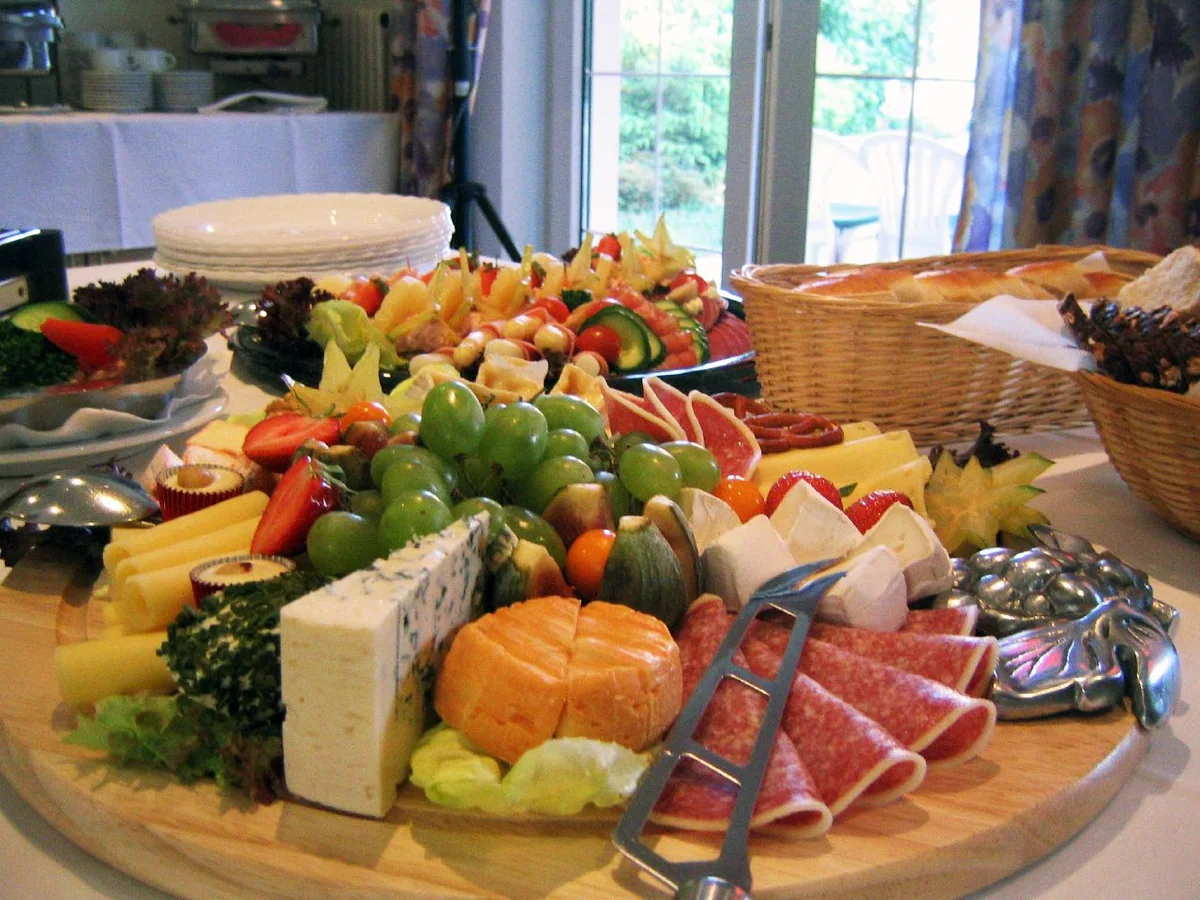
A buffet with vegetables, bread, cold dishes and serving plates. Photo: Torsten Seiler from Cologne, Germany, Buffet Germany.jpg, CC BY-SA 2.0. Resized and converted to WebP; the image remains available under its original licence. This is an illustrative photograph, not a Vowlinora case study or a photograph of the worked example.
