
Leftovers can look like an easy way to avoid waste until the reception ends and nobody knows how long a dish has been out, who owns the containers or whether the destination has refrigeration. A responsible plan starts before the wedding, with the caterer and venue, not with guests collecting food from the buffet.
Distinguish unopened stock, food retained under the caterer’s control and food already exposed during service. Those categories may have different options. The caterer must assess what can be released under applicable requirements and its own procedures; the couple should not overrule that assessment to save a tray.
📦 Write a leftovers responsibility sheet
| Task | Named owner | Question to settle |
|---|---|---|
| Assess suitability for release | Caterer | What can be handed over, if anything? |
| Package and identify food | Agreed catering team | Which containers and information are provided? |
| Transport | Named recipient or approved service | Can the required conditions be maintained? |
| Receive and store | Destination contact | Is suitable capacity genuinely available? |
| Dispose of unsuitable food | Venue or caterer | Who handles waste and cleaning? |
A good plan includes the possibility that no perishable leftovers will be released. That is a valid outcome, not evidence that someone failed to care about waste. Reducing over-ordering and improving guest-count accuracy may be more effective than relying on an uncertain end-of-night rescue.
Use official guidance in its proper scope
The United States FDA’s consumer guidance on safe buffets advises discarding perishables left at room temperature for more than two hours unless appropriately kept hot or cold; the limit becomes one hour when the ambient temperature is above 90°F. Its outdoor-eating guidance likewise emphasises time and temperature control.
Those are U.S. consumer guidelines, not a universal commercial catering procedure or a fresh allowance that starts when food is packed. Do not reset the clock at handover. Professional operators may work under different jurisdiction-specific rules and documented controls. Ask the caterer to determine the relevant process and provide clear instructions for any approved handoff.
An illustrative handoff decision
Assume, for illustration, that a reception ends at 22:00 and the intended recipient reaches home at 22:45. The journey is 45 minutes, but that number alone says nothing about whether the food is suitable to take. Its earlier preparation, holding, service exposure and transport conditions also matter.
The recipient tells the caterer the actual journey and destination arrangements in advance. The caterer decides whether any items can be released and what conditions would be required. If the destination cannot meet those conditions, the handoff does not go ahead. This example deliberately avoids turning travel duration into a safety guarantee.
Arrange the process before the event
- Ask the caterer what its contract allows concerning leftovers.
- Confirm venue restrictions and any approved donation arrangements.
- Name a sober, available recipient who understands the handoff conditions.
- Agree containers, labels, transport and destination capacity.
- Let the caterer assess the actual food at the end of service.
- Follow the supplied instructions or decline the handoff if conditions cannot be met.
- Dispose of unsuitable food through the agreed waste process.
Do not create a donation plan by arriving unannounced at a charity with mixed trays. Acceptance rules, traceability, timing and transport need prior agreement with an organisation able to receive the food. An intention to donate does not remove handling responsibilities.
What not to improvise
Avoid tasting food to decide whether it is safe, inventing preservation methods or asking a relative to cool a large tray without instructions. Reheating is not a universal fix for poor handling. Any storage and reheating guidance should come from the caterer and relevant official authority for the actual food and location.
The takeaway is to decide ownership and feasibility early, then let the actual food-safety assessment govern the outcome. A thoughtful leftovers plan protects people first and treats waste reduction as a practical system rather than a late-night promise.
Sources and further reading
Photograph credit
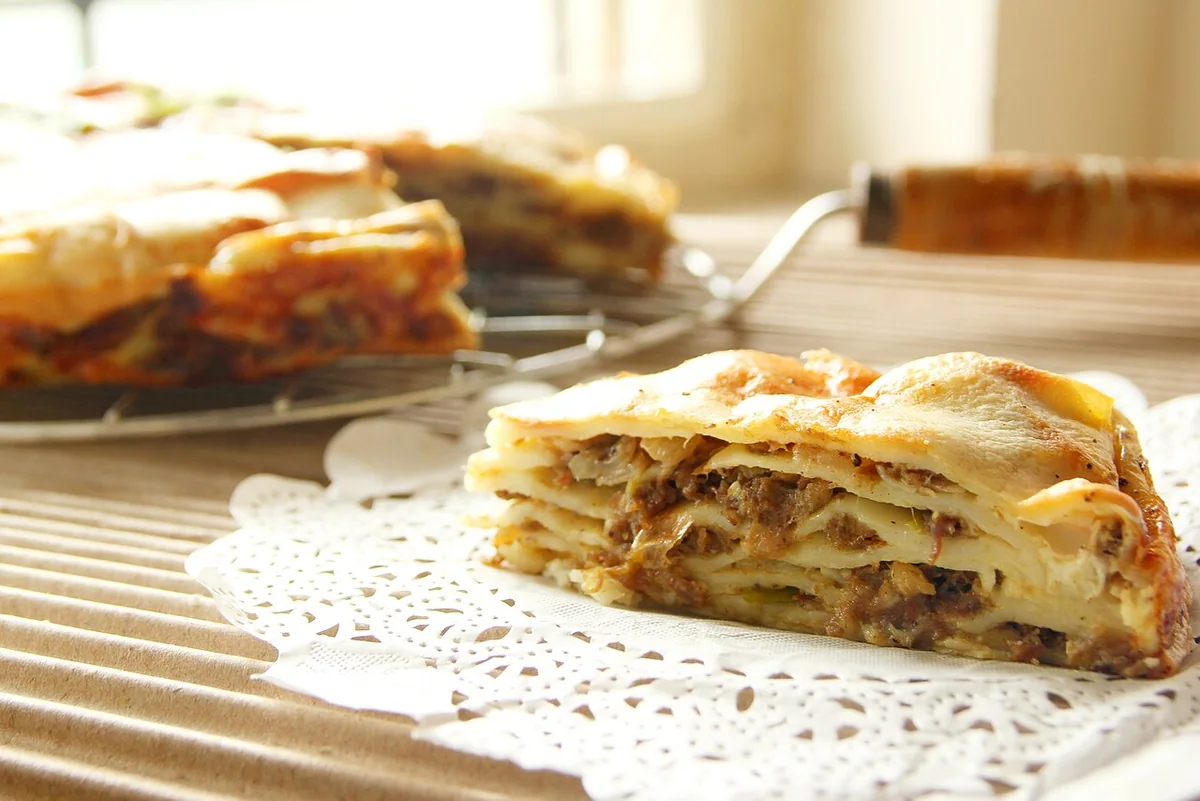
A sliced layered chatti pathiri dish on a serving surface. Photo: Silsilah Ali, Chatti pathiri.JPG, CC BY-SA 4.0. Resized and converted to WebP; the image remains available under its original licence. This is an illustrative photograph, not a Vowlinora case study or a photograph of the worked example.
