
A venue can be close to a city and awkward to reach. The final connection may involve an unlit lane, a station without the required facilities, or a taxi service that does not operate when the reception finishes. Evaluate the journey guests will actually make, including the return leg. A map pin measures location; it does not describe the experience of arriving dressed for a celebration.
🧭 Trace three realistic journeys
Choose representative routes rather than trying to predict every guest’s movements. Consider someone arriving by public transport, someone driving, and someone requiring an accessible vehicle or assistance. Trace each route from a realistic starting point through the venue door. Ask operators about current arrangements rather than assuming an online journey planner contains all relevant access information.
For example, UK government guidance explains that train operators provide information about accessible facilities and assistance, including during disruption, through their Accessible Travel Policies. This is a UK example, not a promise about rail systems elsewhere. In any country, ask the relevant operator what assistance, vehicle space, booking arrangements, and disruption support are actually available for the proposed journey.
Record the connections that can fail
| Connection | Verify with | Useful answer |
|---|---|---|
| Station to venue | Transport operator and venue | Actual pickup point and usable drop-off |
| Parking to entrance | Venue manager | Surface, distance, lighting, and step-free route |
| Late return | Local licensed transport provider | Operating hours and reservation conditions |
| Disrupted arrival | Operator and event contact | A contact method and realistic alternative |
Ask whether coaches can enter, turn, and wait legally and safely. A picturesque gateway may be unsuitable for the intended vehicle. Have the transport operator and venue confirm access together; neither a couple’s estimate nor a vehicle photograph settles the question. Similarly, check where taxis collect at night if the daytime entrance closes or becomes a supplier exit.
An illustrative journey audit
Assume a fictional rural venue is fifteen minutes from a railway station in light traffic. The couple initially describes it as easy by train. Their audit finds that the last scheduled connection home leaves before dinner ends, the station taxi rank is not reliably staffed, and the proposed shuttle has not been confirmed suitable for one guest’s wheelchair. The short driving distance has concealed three separate decisions.
They ask a local operator about an appropriate vehicle, share the proposed drop-off with the venue, and revise guest information to distinguish travel they are arranging from travel guests must arrange themselves. They also tell guests that returning by train that night would require leaving early. These assumptions illustrate the method; they are not real service times, travel guarantees, or recommendations about any operator.
Make the venue prove the arrival works
- Visit the actual public entrance and pickup point rather than relying on the postal address.
- Ask who manages arrivals when several vehicles appear together.
- Confirm what happens in heavy rain and after dark.
- Check phone reception or another reliable contact method at the collection area.
- Provide written directions that name landmarks, entrance restrictions, and the correct event contact.
Do not publish individual guests’ assistance requirements in group transport messages. Share necessary operational information only with the people arranging the relevant service. Ask guests how they prefer to coordinate assistance and whether they want direct contact with an operator. Helpful travel planning should preserve independence, not require someone to explain personal information repeatedly to strangers.
Transport availability changes, and a venue cannot guarantee a public network. Keep the distinction between verified arrangements and suggestions clear. A confirmed shuttle is different from a list of taxi numbers; a nearby hotel is different from an available accessible room. Prefer venues whose staff answer practical route questions honestly, because the celebration begins before guests reach the ceremony and ends only when they can leave comfortably.
Sources and further reading
Photograph credit
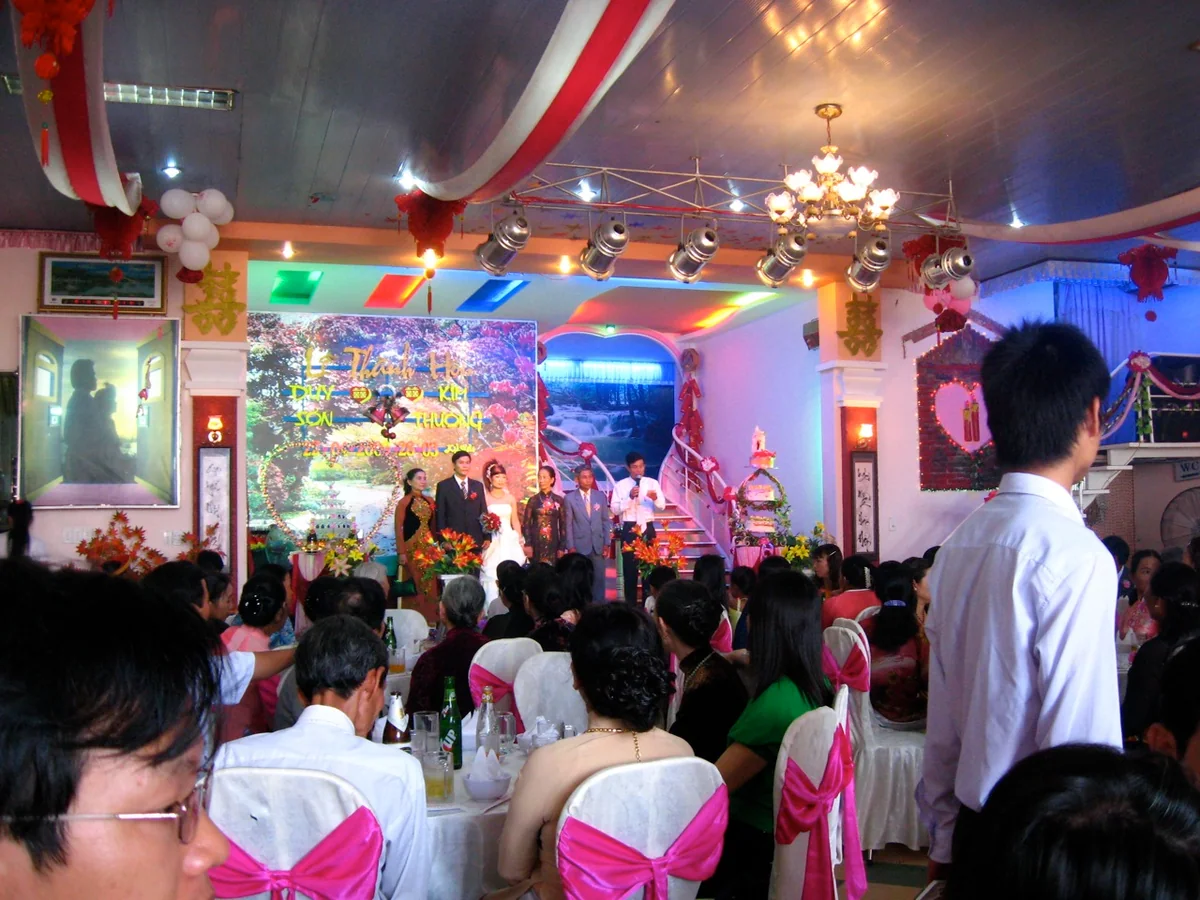
Tables arranged for an indoor Vietnamese wedding reception. Photo: Dragfyre, Vietnamese wedding reception.jpg, CC BY-SA 3.0. Resized and converted to WebP; the image remains available under its original licence. This is an illustrative photograph, not a Vowlinora case study or a photograph of the worked example.
