A venue can have a step-free front door and still be difficult to use. The ceremony may be across gravel, the accessible toilet may become a storage room, or the evening exit may require a different route. An accessibility walkthrough is therefore a journey, not a single question answered at reception. Your aim is to collect specific information that guests can use to make their own decisions.
🔎 Start with people, not assumptions
Invite guests to share access requirements privately, without asking for diagnoses. Ask what would make arrival, movement, communication, and resting easier. A wheelchair user and a person who cannot stand for long may need different things. Do not recruit one disabled guest to certify the building for everybody. Offer photographs, route descriptions, and a contact person so guests can judge what matters to them.
W3C’s accessible-events guidance specifically includes entrances, meeting spaces, stages, bathrooms, and information about accessible routes. In the United States, ADA obligations depend on the entity and circumstances; the Department of Justice also explains effective communication and service-animal provisions. These are not worldwide standards or a substitute for checking local requirements. Ask the venue who is responsible for accessibility decisions and unresolved barriers.
Walk the event as it will actually operate
Begin at the real drop-off point rather than the sales office. Follow the proposed route with doors in their normal positions. Ask about surfaces, gradients, thresholds, lifts, seating, and distance. Continue to the ceremony, meal, dance area, toilets, quiet space, and departure point. Repeat the conversation for rain arrangements. A usable garden route does not establish that the indoor replacement works equally well.
| Journey stage | Evidence to request | Unresolved decision |
|---|---|---|
| Arrival | Drop-off photograph and surface description | Who keeps the route available? |
| Ceremony | Seating layout with companion spaces | Can guests choose where to sit? |
| Facilities | Toilet location and usable route | Who prevents storage blocking access? |
| Departure | Evening exit and transport arrangements | What changes after the main doors close? |
An illustrative route comparison
Assume a fictional venue offers a courtyard ceremony and a dining room upstairs. The courtyard is level from the entrance, but the lift to dinner is normally locked. A sales description says the property is accessible. That description is not enough: the couple asks who unlocks the lift, whether it serves the required floor during the event, and what the venue’s arrangements are if it becomes unavailable.
The couple also learns that the wet-weather ceremony uses a room reached through the kitchen corridor. They request an alternative guest route and an accurate description for affected guests before committing. These illustrative assumptions do not establish that any particular layout complies with law. They show why an operational answer, with an owner, is more valuable than a reassuring adjective.
📝 Turn observations into agreed actions
- Record each route and barrier in plain language, with venue permission for useful photographs.
- Ask the venue to confirm what will change, who will do it, and when it will be ready.
- Share relevant details privately with guests who requested them and invite corrections.
- Ask the venue about evacuation arrangements, including assistance for disabled guests; do not improvise lifting or carrying plans.
- Recheck the agreed layout after furniture and equipment have been positioned.
Communication belongs in the same discussion. Ask whether ceremony audio, captions, interpretation, large-print information, or other aids are needed, then involve the guest and appropriate professionals. A microphone alone does not meet every hearing need, just as a ramp alone does not establish complete access. Service animals should not simply be handled under an ordinary pet policy; applicable rules need separate checking.
Finally, describe limitations honestly. Historic buildings, temporary structures, and outdoor terrain may present barriers that the venue cannot remove for your date. Concealing those barriers is worse than identifying them early. A strong venue choice is one whose team provides reliable specifics, accepts responsibility for agreed actions, and helps guests participate without making them negotiate every doorway on the day.
Sources and further reading
Photograph credit
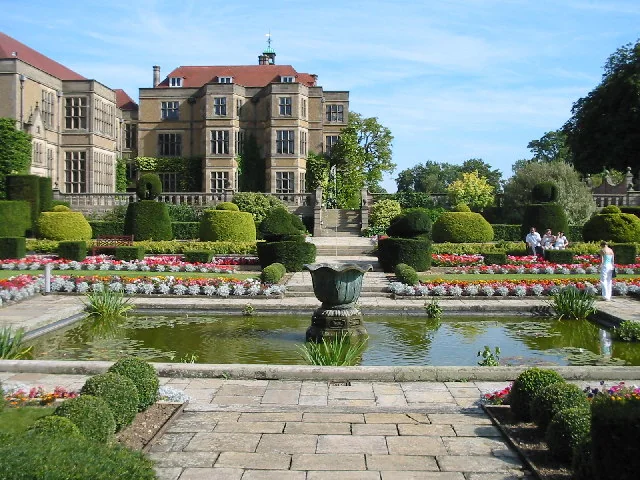
Fanhams Hall viewed across its garden in Hertfordshire. Photo: Darren Smith, Fanhams Hall, near Ware, Herts – geograph.org.uk – 15874.jpg, CC BY-SA 2.0. Resized and converted to WebP; the image remains available under its original licence. This is an illustrative photograph, not a Vowlinora case study or a photograph of the worked example.
