Seeing the same wedding idea repeatedly does not tell you how many couples use it. A feed is a selection of content, not a census of celebrations. That distinction matters when a beautiful idea arrives with pressure to adopt it before it becomes dated. You can enjoy inspiration without accepting an unsupported claim about what everyone is doing.
🔎 Ask what the evidence measures
A popular image might demonstrate that people like looking at an installation, not that they booked one. A supplier’s portfolio may show that the supplier offers a service, not that it dominates the wider market. A survey can provide useful evidence, but only if you know who was asked, what they were asked, and which events their answers describe.
Pew Research Center’s questionnaire guidance explains that wording, order, and consistency affect what survey answers mean, especially when measuring change. Apply that principle when reading wedding reports: a question about interest is not the same as a question about actual use, and different question wording can complicate a comparison. Do not turn a preference poll into a booking statistic.
Build an evidence ladder
| Evidence | Useful for | Does not establish |
|---|---|---|
| Repeated social images | Finding a visual idea | How common it is at weddings |
| Supplier examples | Understanding available services | International adoption |
| Transparent survey | Understanding the defined respondents | Every couple’s preferences |
| Comparable observations over time | Assessing change in a defined context | A universal forecast |
Check whether several posts originate from the same styled shoot or supplier campaign. Repetition can make a single example feel like many independent examples. Look for an original credit, event description, and publication date. If those are missing, treat the image as inspiration rather than evidence of real-world prevalence. You do not need to accuse anyone of deception to recognize that the information is incomplete.
An illustrative claim audit
Assume a fictional article says that audio guestbooks are replacing written guest books everywhere. Its supporting examples come from a rental company’s social account, and the article provides no sample, geography, comparison period, or definition of replacing. A careful reader can conclude that the product exists and is being promoted. The evidence does not establish a worldwide replacement pattern.
The reader then asks a more useful personal question: would hearing guests’ voices be meaningful, and can the service work comfortably at this event? This moves the decision from an unsupported popularity contest to a practical evaluation. The example is illustrative, not a criticism of any named business or a claim that the idea is unpopular.
Notice commercial context
The US Federal Trade Commission’s influencer guidance describes disclosures for material connections, including paid or gifted relationships. That is US guidance, not a universal international legal summary. Its practical reading lesson is broader: knowing whether a recommendation has a commercial connection helps you assess it. A clear disclosure does not make an idea bad; an attractive post does not become independent research merely because it looks personal.
- Find the original source rather than relying on a repost.
- Identify the claim: visibility, preference, bookings, or a forecast.
- Look for the relevant population, date, method, and wording.
- Separate commercial examples from independent evidence.
- Evaluate the idea’s purpose at your wedding even if the trend claim remains unproven.
Evidence may be unavailable, and that is a valid result. You can say an idea is visible in your inspiration collection without calling it the defining look of a year. A good wedding decision does not require proof of popularity. It requires a clear reason to choose something, realistic delivery, and permission to leave it behind when it serves the feed better than the people attending.
Sources and further reading
Photograph credit
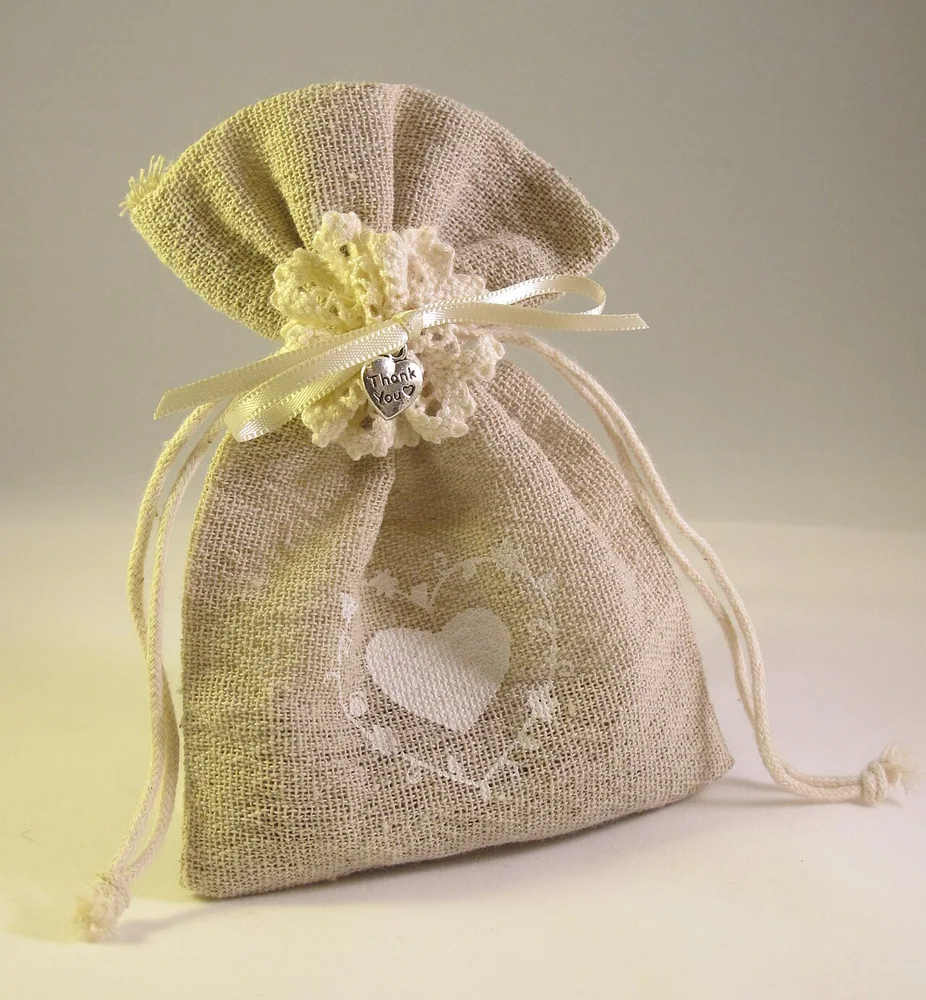
A small rustic wedding favour bag decorated with lace and ribbon. Photo: Missgmatthews, Rustic Wedding Favour.jpg, CC BY-SA 4.0. Resized and converted to WebP; the image remains available under its original licence. This is an illustrative photograph, not a Vowlinora case study or a photograph of the worked example.
