A styled wedding shoot is not a failed real wedding. It is a different kind of production, often created to explore an idea, show supplier work, or build a portfolio. Problems arise when its images are treated as a complete account of how an ordinary celebration functions. Learn to translate inspiration rather than dismissing it or expecting your day to reproduce it frame for frame.
📷 Identify what the image actually shows
A table photograph can demonstrate color, texture, and an arrangement. It may not show where guests’ coats go, how food reaches the table, or what happens when somebody stands. A portrait can demonstrate a photographer’s visual approach without showing how they document a fast-moving ceremony. Ask what conditions produced the image before deciding what it proves.
Photographer Anna O. Brambilla’s professional explanation distinguishes controlled styled shoots from the changing conditions of real weddings and recommends viewing complete galleries. This is a practitioner’s perspective, not an independent test of every photographer. It supports a sensible evaluation method: look beyond isolated highlights and ask for examples relevant to the event you are commissioning.
Translate the reference into a brief
| What you like | Ask | Relevant evidence |
|---|---|---|
| Intimate portraits | What conditions and time did this require? | Comparable complete wedding coverage |
| Layered table | How does dinner service work around it? | A usable proposed arrangement |
| Dramatic location | Was access exclusive or specially arranged? | Permissions relevant to your booking |
| Evening atmosphere | What lighting was added? | Your photographer’s proposed approach |
Do not assume that an empty table or a polished couple proves an image is staged. Real weddings can produce both. Ask the creator directly and respectfully whether the work came from a live event, editorial production, workshop, or another setting. The important distinction is context, not a visual detective game that labels every unusually beautiful photograph suspicious.
An illustrative inspiration translation
Assume a fictional couple saves an image of a long outdoor table surrounded by candles. They love the close, warm feeling and initially ask to copy every detail. Their venue explains that the image’s furniture arrangement would conflict with the proposed service route and that open flames have restrictions. The photographer notes that the reference may also use added lighting outside the frame.
The couple extracts the qualities they actually want: a shared-table atmosphere, warm light, and a sense of enclosure. Their suppliers propose a different arrangement that supports those qualities within the venue’s conditions. These assumptions illustrate interpretation, not a real design review or a guarantee of matching results. The reference becomes a starting point rather than a specification that overrides practical needs.
Ask for a complete story
When reviewing a photographer, request relevant full galleries that can be shared with the pictured clients’ permission. Notice transitions, ordinary indoor moments, mixed groups, and evening coverage, not only portraits. Ask what the photographer would approach differently at your venue. A complete gallery helps you understand consistency, but it does not guarantee identical conditions or eliminate the need for a clear agreement.
- Label saved references by the quality you value.
- Record whether their production context is known.
- Ask affected suppliers what would be required to adapt the idea.
- Check venue restrictions before treating an installation as achievable.
- Keep the experience of people attending ahead of exact visual replication.
Nikon’s wedding-photography feature offers a useful companion perspective: a professional describes working with location, window light, reflectors, and flash. The resulting image is a collaboration between environment and technique, not simply a venue feature that can be purchased unchanged.
The limitation is that no portfolio gives you total access to how an event felt. Use images to ask better questions, not to promise a flawless day. A wedding can be visually coherent while containing movement, weather, wrinkled clothing, and people who do not behave like models. Those differences are part of the celebration, not evidence that the inspiration has failed.
Sources and further reading
Photograph credit
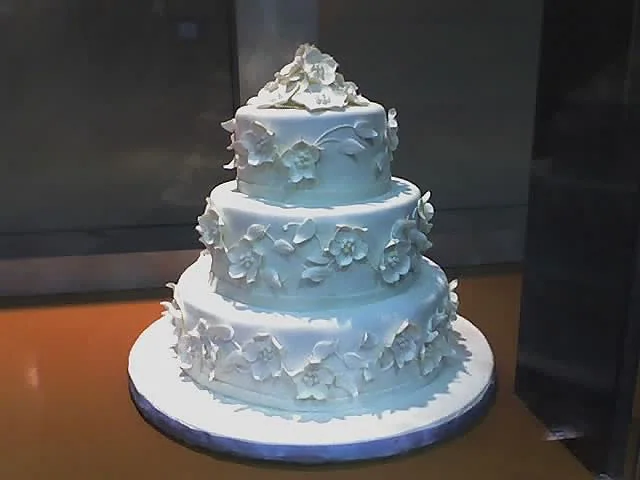
A pale blue tiered winter wedding cake with decorative details. Photo: cara fealy choate from Austin, USA, Winter Wedding Cake.jpg, CC BY 2.0. Resized and converted to WebP; the image remains available under its original licence. This is an illustrative photograph, not a Vowlinora case study or a photograph of the worked example.
