A ceremony sign, guest-book stand or group of hired ceramic objects may serve a second purpose at the reception. The saving depends on more than owning fewer things. Someone must release each object, move it along an approved route, account for its parts and hand it to the person preparing the next space.
This guide covers non-floral, non-electrical objects that the supplier and venue have approved for straightforward relocation. It is not a handling method for structural, suspended or technically installed work. For living arrangements, use the separate florist-led flower reuse assessment, which deals with construction, water, condition and acceptance after a move.
📦 Give objects identities and owners
Create an item register before drawing arrows between rooms. Use one identifier for each complete object or clearly defined set. Photograph its components with permission: a display may include a board, support, removable insert and protective packaging owned by different people. Record which parts must travel together and which remain at the ceremony.
Distinguish ownership from responsibility. A rental company may own the stand while a coordinator receives it and a consenting helper moves an approved small sign. The helper does not acquire permission to alter the stand, change its placement or accept additional rental charges. Confirm these boundaries with the owner.
| ID and item | Property owner | Release and destination | Accountable handoff |
|---|---|---|---|
| S01: sign and approved support | Sign purchased; support hired | Released after ceremony arrivals; reception foyer | Coordinator checks both pieces with receiver |
| G01: guest book and pen tray | Couple | Released after final ceremony message; dining-room welcome desk | Named helper delivers; desk contact acknowledges |
| C01: four ceramic objects | Rental supplier | Supplier-approved move to four labelled positions | Decor team counts four out and four in |
The quantities and roles are fictional. Add actual packaging instructions, return references and a final collection owner to your own register. Do not mix hired objects into personal gift boxes merely because they share a destination.
Walk the route before assigning the task
Ask the venue to confirm doors, stairs, lifts, loading access and any periods when guests or catering use the same route. Measure an uncertain doorway with permission rather than estimating from a photograph. Ask the supplier whether the intended item and approved packaging suit that journey; do not invent a carrying or loading technique.
Identify a receiving point that is available when the object arrives. A foyer may be an excellent display location but an unsuitable temporary store during arrivals. If the destination is occupied, the plan needs an approved holding point or an omission decision, not a pile beside an exit.
HSE event guidance supports coordinating work and sharing relevant site information across event phases. It does not validate this register or establish that a particular route is safe. The venue and responsible suppliers retain their actual operational roles.
⏱️ Calculate the window from release to acceptance
For an illustrative move, assume all listed objects are released at 14:30 and the receiver must accept the completed display by 15:10. The available window is 40 minutes. The agreed team estimates eight minutes to check and pack, twelve to move, and fifteen to place and reconcile: 35 minutes of work, leaving five minutes unallocated.
If release slips to 14:40, only 30 minutes remain. The same 35-minute job is five minutes late. Finishing another task early does not fix that dependency. The coordinator must use the previously agreed fallback, such as omitting the ceramic grouping, rather than asking helpers to rush or sending equipment through guests.
- Confirm the release cue with the person controlling the first space.
- Record supplier-validated work durations and actual team availability.
- Have the venue approve the route and receiving point.
- Choose which optional item is omitted if the window closes.
- Ask the receiver to confirm item IDs, counts and placement.
- Record where packaging and objects go after the reception.
Compare the complete commitment
Price agreed transfer labour, waiting, transport and any later collection against a simpler separate display. Reuse is not automatically cheaper or environmentally preferable. Keep the approved inventory version with the event brief, and record a change when an item, owner or destination changes. A successful transfer ends with an acknowledged count and clear return responsibility, not simply an empty ceremony room.
Sources and further reading
Photograph credit
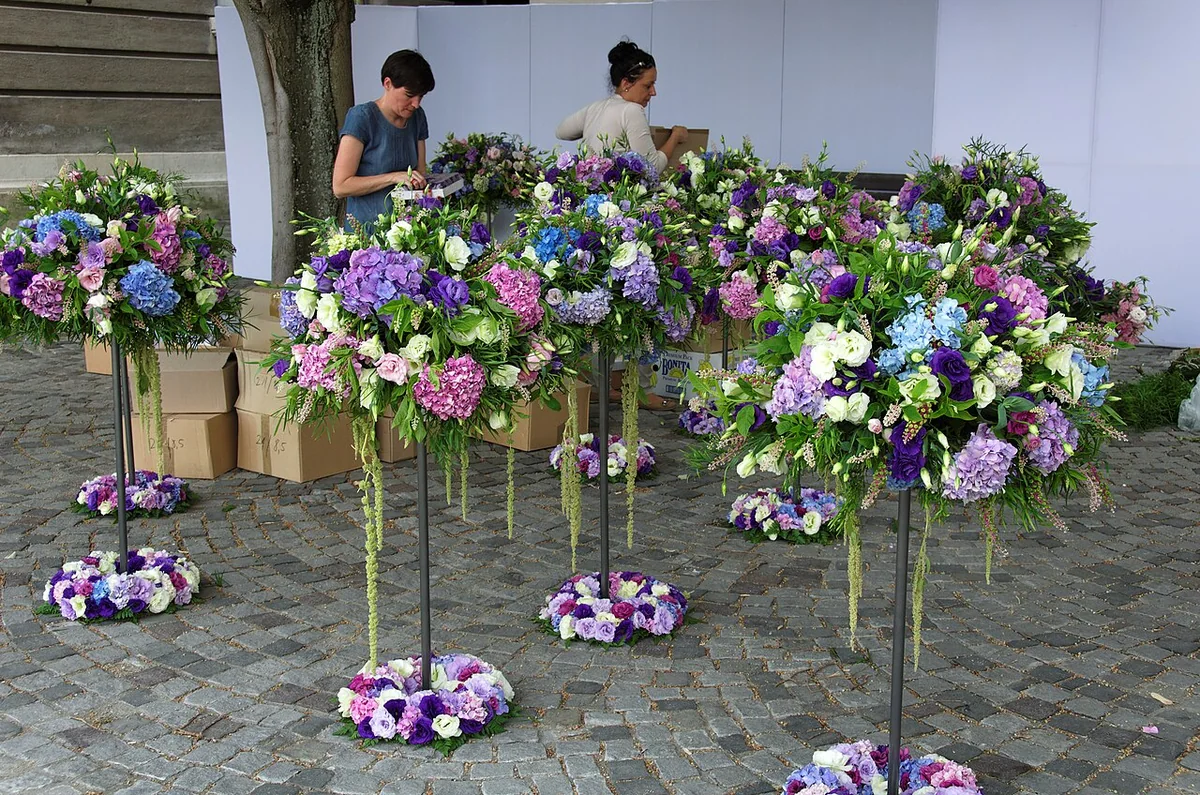
Florists arranging purple and white flowers on tall reception stands. Photo: Yelkrokoyade, Flower table decoration Wedding in Budapest.jpg, CC BY-SA 3.0. Resized and converted to WebP; the image remains available under its original licence. This is an illustrative photograph, not a Vowlinora case study or a photograph of the worked example.
