
Lighting decisions are easier when you stop asking whether a room needs “more lights” and start asking what people must be able to do. Guests need to find their way, read information, see one another and enjoy the atmosphere. Those needs may require different solutions.
This walkthrough is a briefing tool, not an electrical installation guide. Existing venue systems, temporary lighting and emergency arrangements require appropriate professional management. The HSE’s electrical-safety guidance identifies environmental conditions, power needs, cable routing and emergency lighting as relevant planning considerations.
💡 Walk through by activity
Arrange a visit when the venue can demonstrate its intended evening settings. If that is impossible, ask for a supplier-led demonstration or record the limitations of a daytime visit. Do not assume a photograph reveals how easily a menu can be read in person.
- Map arrival, dining, speeches, dancing and departure.
- Ask the venue to show the existing lighting for each area.
- Check practical tasks from the guest’s position.
- Identify places where glare, deep shadow or reflections cause difficulty.
- Ask the lighting supplier for a proposal addressing those specific problems.
- Confirm who operates changes during the event.
Keep official exit signs, routes and emergency lighting outside decorative experimentation. Do not ask a supplier to darken an essential route simply to improve a photograph. The venue should confirm any operational limitations.
A worked room-by-room brief
Assume an illustrative reception with an entrance foyer, dining room and separate dancing area. The venue can dim the dining lights, but the couple has not yet agreed a level. The following entries are hypothetical observations to make during a future walkthrough, not findings from a real test.
| Area | Task to check | Question for venue or supplier |
|---|---|---|
| Foyer | Read seating information | Can the board be seen without glare? |
| Dining tables | Read menus and see faces | Which existing setting supports both? |
| Speech position | See the speaker clearly | Does the proposed light create uncomfortable glare? |
| Departure route | Navigate safely | What remains operational throughout? |
Only after those questions are answered should you decide whether decorative uplighting or other additions serve a clear purpose. An existing setting may already do the job. More equipment is not automatically a better design.
Check materials under the proposed light
Bring a representative linen, stationery sample and any reflective vessel. X-Rite’s explanation of metamerism shows why materials can appear to match under one light and diverge under another. You are checking the actual combination, not trying to certify colour accuracy.
Ask your photographer what information they need about the lighting plan. Their preferences are one input alongside guest comfort and venue operations, not a reason to disregard essential visibility. Avoid promising that a particular colour or fixture will guarantee flattering photographs.
If coloured or changing effects are proposed, discuss guest needs and the option of a calmer setting. Do not assume everyone is comfortable with moving or flashing effects. Specific medical questions belong with the affected person and appropriate professionals, not a generic decorating article.
Close the operational gaps
Confirm installation and removal times, power responsibilities, operator availability and what happens if a decorative element fails. Supplier documentation should address the technical design. Never improvise cable routes, power distribution or protection from weather based on a styling worksheet.
Write down the agreed scene changes in the event timeline, using plain labels such as dinner, speeches and dancing. Name the person authorised to request a change so multiple guests do not give conflicting instructions.
The useful takeaway is a lighting brief defined by activities and constraints. It lets professionals propose an appropriate solution while keeping guest navigation, readable information and atmosphere in the same conversation.
Sources and further reading
Photograph credit
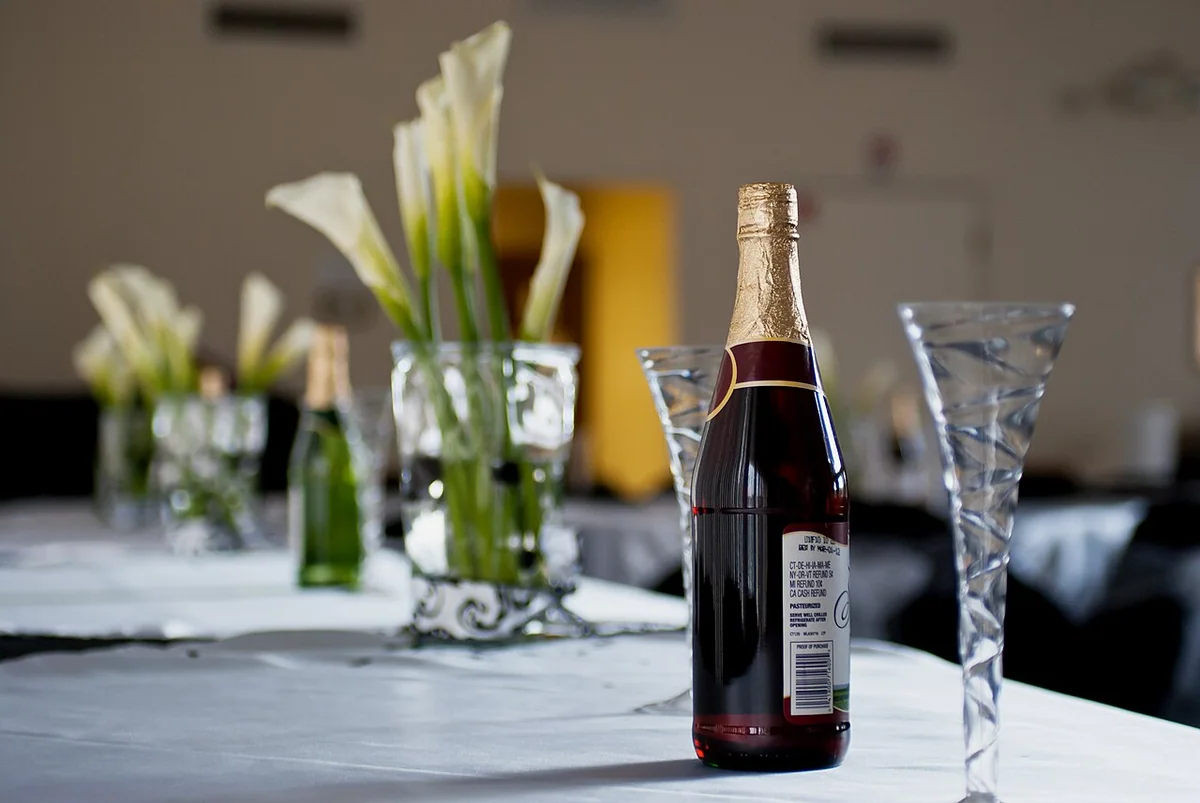
Bottles, glassware and flowers arranged on a reception table. Photo: Robert Bejil from Bakersfield, Ca, USA, Reception table setting.jpg, CC BY 2.0. Resized and converted to WebP; the image remains available under its original licence. This is an illustrative photograph, not a Vowlinora case study or a photograph of the worked example.
