
Transporting a wedding dress involves three separate questions: how the gown should be packed, what the carrier allows and what preparation will be available at the destination. A garment bag does not answer all three. Obtain advice for the actual dress and the actual journey before deciding how it will travel.
For US airport screening, the Transportation Security Administration says a wedding dress can pass through screening and recommends protective packaging. It separately advises contacting the airline about bringing and stowing the dress and carry-on limits. Security permission is not an airline storage guarantee, and TSA guidance does not establish rules for other countries.
🧳 Build a dress-specific travel plan
Ask the boutique or manufacturer how the garment should be supported and packed. Share the journey details, including connections, ground transport and time before wear. Mixed fabrics, embellishments and construction may affect the advice; a generic folding video is not a substitute.
- Obtain the gown’s care information and packing recommendation.
- Check each carrier’s current baggage and stowage rules.
- Measure the packed bag against the applicable allowance.
- Confirm destination storage and any professional preparation service.
- Pack accessories separately enough to avoid pressure or snagging.
- Keep the care instructions and relevant contacts accessible.
Do not assume cabin hanging space will exist or that staff can make an exception. Ask what happens if the bag cannot remain where you expect, and decide whether the resulting uncertainty is acceptable before travelling.
A worked connection scenario
Assume an illustrative journey involving two flights operated by different carriers, followed by a car transfer. The gown has a decorated bodice and layered skirt. No carrier allowance or care method is assumed in this example.
| Stage | Confirmation needed | Fallback question |
|---|---|---|
| First flight | Packed dimensions and allowance | What if cabin storage changes? |
| Connecting flight | Rules of the actual operating carrier | Does the same bag remain acceptable? |
| Car transfer | Suitable protected space | Can other luggage be arranged differently? |
| Destination | Gown-appropriate storage and preparation | Who can advise if creasing appears? |
The connection is the weak point if only the first carrier has been checked. A bag that works on one aircraft or ticket may not fit another arrangement. Obtain current answers directly rather than copying limits from an old travel article.
Do not make heat the default
Ask whether steaming, pressing or another method is appropriate for the exact gown. Follow the label, manufacturer guidance and a qualified cleaner’s assessment where necessary. Decorative components can make a general fabric recommendation unsuitable for the complete garment.
Maggie Sottero’s satin-care article discusses storage and cleaning with reference to care instructions. That source is specific to its subject and does not establish a safe procedure for every wedding dress. This travel plan deliberately gives no universal heat setting, steam distance or stain-treatment recipe.
Check whether a destination service needs advance booking and whether it can assess your gown. A hotel having an iron does not mean it offers suitable bridal preparation. Build the actual appointment into your schedule if professional help is required.
Inspect without improvising
On arrival, unpack according to the agreed advice and look for visible issues in a clean, suitable space. If something needs attention, contact the relevant professional before trying an unfamiliar treatment. Avoid sprays, adhesives or household cleaning products unless appropriate guidance specifically supports their use.
Keep small accessories accounted for with a packing list, but do not place sharp or heavy items where they can damage the gown. Check screening rules separately for any tools or liquids you carry.
The useful takeaway is a confirmed chain of decisions: gown-specific care, carrier-specific transport and a realistic destination plan. None guarantees a crease-free arrival, but together they reduce avoidable assumptions.
Sources and further reading
Photograph credit
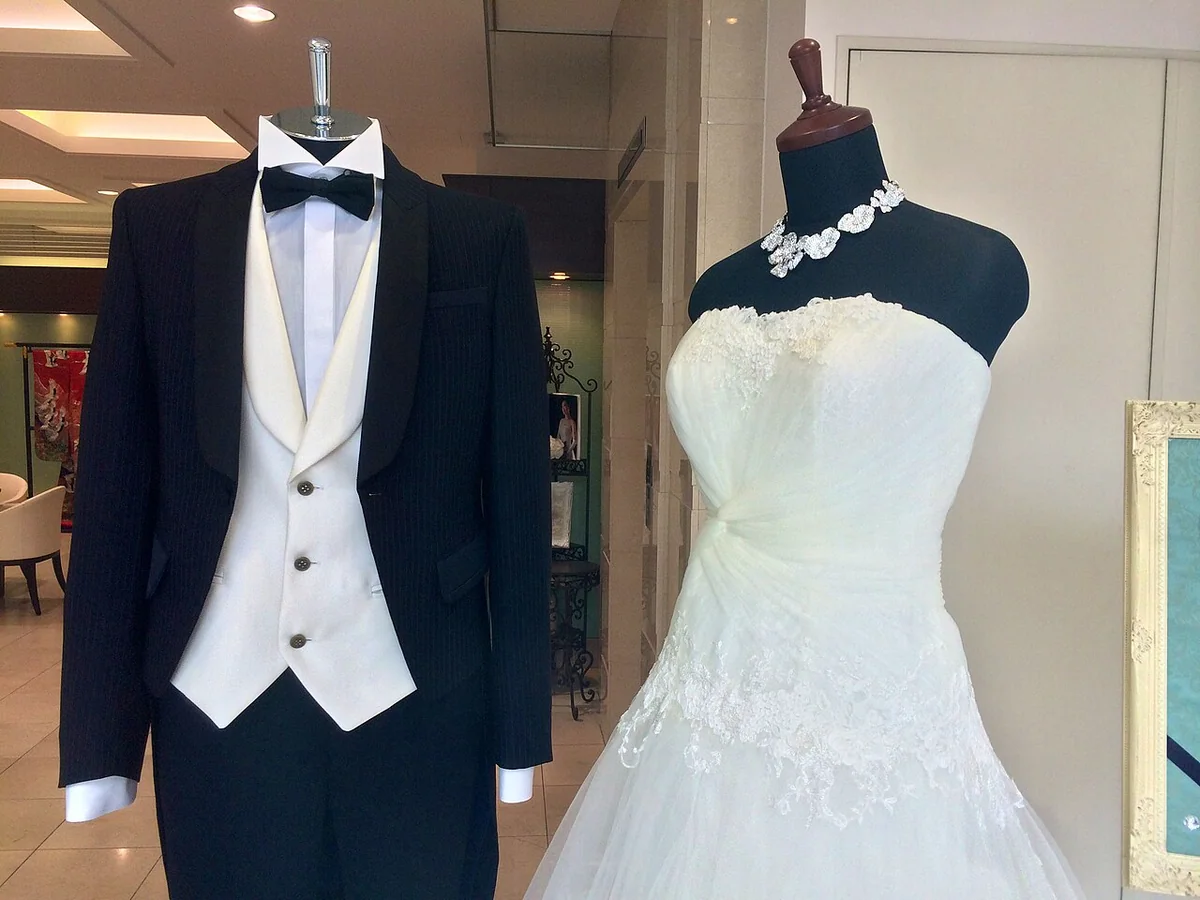
A formal suit and a white wedding dress displayed together. Photo: Steven-L-Johnson from Philadelphia, Wedding attire (14268729341).jpg, CC BY 2.0. Resized and converted to WebP; the image remains available under its original licence. This is an illustrative photograph, not a Vowlinora case study or a photograph of the worked example.
