
Agreeing to attend a wedding does not tell you how someone feels about appearing on a public account. A guest may enjoy group photographs but avoid being tagged, prefer not to reveal their location, or keep children off social media. Treat capturing, sharing, and identifying as separate decisions. This is a practical respect-and-consent approach, not a statement that one legal rule governs every photograph worldwide.
🔒 Define the audiences
A photograph sent directly to the people in it has a different audience from a wedding hashtag, a supplier portfolio, or a public magazine submission. Ask what you intend to do with pictures before asking guests for permission. Vague language such as wedding use can conceal several purposes. Your photographer and other suppliers also need to explain their own publication practices and applicable terms.
EFF’s social-network guidance highlights audience settings, location information, tagging, and the identifying details that images can reveal. It also warns that privacy settings can change. These are concrete reasons not to assume that a private-looking platform or a closed album prevents copying or wider circulation. A helpful policy describes both the intended audience and the limits of control.
Use a simple sharing matrix
| Action | Ask | Respectful default when uncertain |
|---|---|---|
| Take a close photograph | Is the person comfortable? | Ask or choose another subject |
| Send to a small group | Who will receive it? | Keep the audience limited |
| Tag or name someone | Do they want to be identified? | Leave names and tags out |
| Publish publicly | Has this use been clearly discussed? | Wait for a specific answer |
Do not ask guests to explain the reason for a privacy preference in a group chat. A simple no-public-images request should be actionable without revealing family circumstances or personal history. For children, involve the appropriate responsible adults and take the child’s comfort seriously where they can express it. Legal consent requirements differ, so seek local professional advice when publication creates a consequential question.
An illustrative group photograph
Assume a fictional couple wants to share a group portrait on an open social account. One friend is comfortable appearing but does not want a name or location attached; another asks not to appear publicly at all. The couple does not interpret the first friend’s answer as permission for everyone. They ask the photographer about an alternative image or an appropriate edit that does not misrepresent what happened.
They also remind guests not to tag the first friend or upload another version containing the second. This cannot guarantee that no copy escapes their control, but it gives people a clear instruction. The example is a decision process, not legal advice or a claim that cropping always resolves privacy. Sometimes the respectful choice is not to post the photograph.
Make requests manageable for suppliers
- Ask each image-making supplier about capture, storage, galleries, portfolios, and public posting.
- Provide privacy instructions through one agreed private channel.
- Discuss how affected people can be identified discreetly without conspicuous labels.
- Keep supplier publication permission separate from guest access to photographs.
- Offer a contact for concerns and respond promptly when someone requests removal from an account you control.
Do not promise that deleting your own post deletes every screenshot, share, or cached copy. EFF’s guidance frames privacy as a shared responsibility; your approach works better when friends understand it too. A short message can ask guests to check before posting identifiable images, avoid live location updates, and respect no-tag preferences without turning the celebration into a lecture.
The useful takeaway is not that wedding photography must become anxious or joyless. Clear boundaries can make people more comfortable being photographed. When the audience and purpose change, ask again. A meaningful memory remains meaningful when it stays in a private album rather than becoming content for strangers.
Sources and further reading
Photograph credit
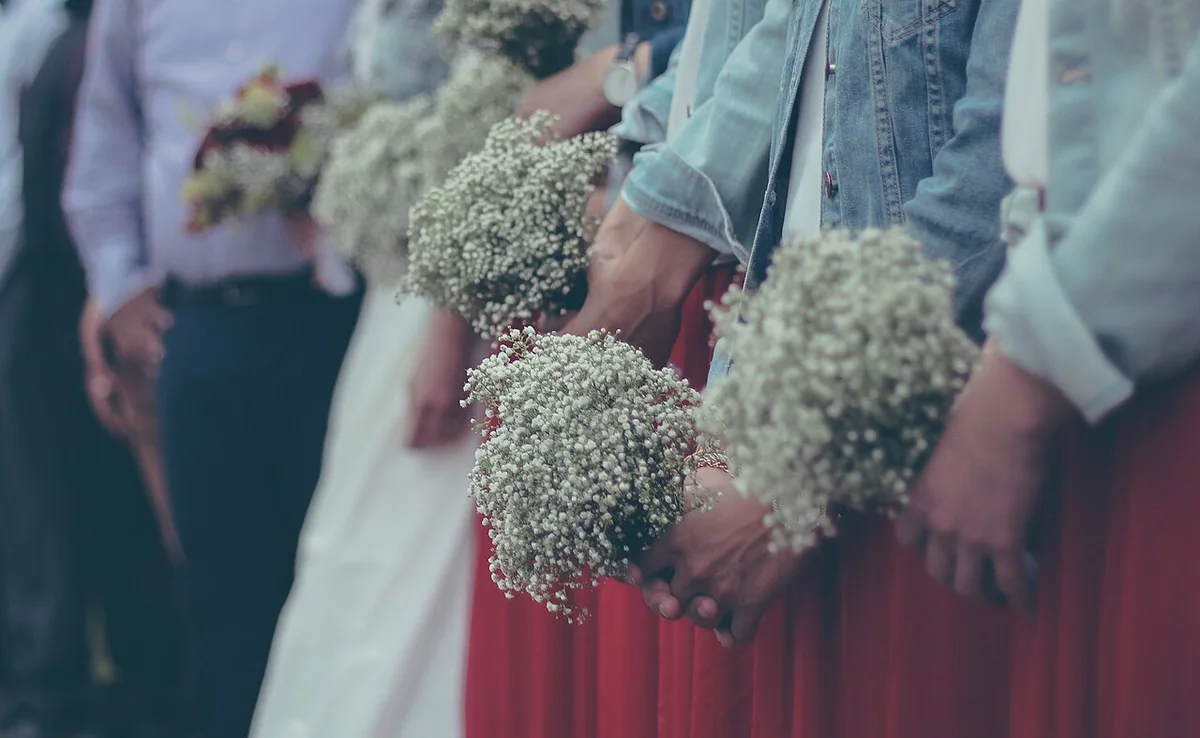
Wedding guests holding small pale flower arrangements. Photo: Tamara Menzi itstamaramenzi, Wedding guests with flowers (Unsplash).jpg, CC0. Resized and converted to WebP; the image remains available under its original licence. This is an illustrative photograph, not a Vowlinora case study or a photograph of the worked example.
