
A dress has to work across more than the weather forecast. You may move between an outdoor portrait session, a heated vehicle, a cool dining room and an active dance floor. Plan comfort by activity and location rather than selecting a fabric solely because a description calls it summery or winter-ready.
Maggie Sottero’s fabric guide distinguishes textures and constructions, while its accessory guidance describes detachable layers such as sleeves, jackets and overskirts. Those options provide vocabulary for a conversation, not a guarantee that a particular garment will keep everyone comfortable in the same conditions.
🌤️ Map the outfit through the day
Write down where you expect to spend time and what can be adjusted. Include transport and waiting periods, which can disappear from a photograph-led plan. Ask the venue about shelter and indoor alternatives rather than treating the outdoor schedule as fixed.
- List the main locations and activities.
- Identify the complete outfit, including lining, undergarments and accessories.
- Try comfortable movement and sitting in the intended combination.
- Discuss removable layers and feasible garment options with the boutique.
- Assign a place and person for storing removed accessories.
- Agree a simpler schedule if conditions are uncomfortable or unsuitable.
This is clothing and logistics guidance, not medical advice. Specific health conditions or temperature-related risks require appropriate individual guidance. Do not use a successful short fitting as evidence that prolonged exposure will be safe.
A worked mixed-location plan
Assume an illustrative celebration with a brief garden portrait session, an indoor meal and dancing in the same building. The shopper likes a sleeveless gown and is considering a detachable wrap. The table records questions to resolve, not predictions of actual weather or comfort.
| Activity | Question | Possible adjustment to assess |
|---|---|---|
| Outdoor portraits | Is shelter available if conditions change? | Shorter session or approved indoor location |
| Vehicle transfer | Can the outfit be seated comfortably? | Practise garment management at fitting |
| Indoor dining | Does the wrap allow comfortable arm movement? | Remove it and store with named helper |
| Dancing | Can the train be managed as intended? | Use specialist-demonstrated arrangement |
The wrap is useful only if it works with the neckline, fastening and movement of this gown. Buying a layer independently without trying the combination can create a new problem. Ask whether the manufacturer offers a compatible option or whether a specialist needs to assess it.
Compare complete construction
A light-looking skirt can contain several layers, while a simple-looking gown may include substantial internal support. Ask what actually touches the skin and how the whole garment feels during the activities you expect. Do not assume a material name predicts the finished gown’s weight or ventilation.
Check shoes and any planned change of footwear with the alteration professional. A hem set for one height may behave differently with another. Do not leave a second pair as an untested last-minute solution if it changes how the dress reaches the floor.
Think about surfaces without treating the dress as outdoor equipment. A long train may need a practical handling plan on paths or grass, subject to the venue and gown specialist’s advice. Avoid choosing unsafe routes simply to protect fabric from marks.
Make adjustments easy
Label a bag or storage location for removable pieces and tell the helper when you expect to use it. If a fastening requires assistance, ask the boutique to demonstrate the process before the event. Do not assume every guest will know how the accessory works.
Review the plan near the event using current venue information and forecasts, while accepting that conditions remain uncertain. Optional photographs or decorative layers can be changed; comfort does not need to be sacrificed to preserve an earlier mood board.
The useful takeaway is an adaptable outfit plan: the actual gown, compatible layers and a schedule that can change when circumstances require it.
Sources and further reading
Photograph credit
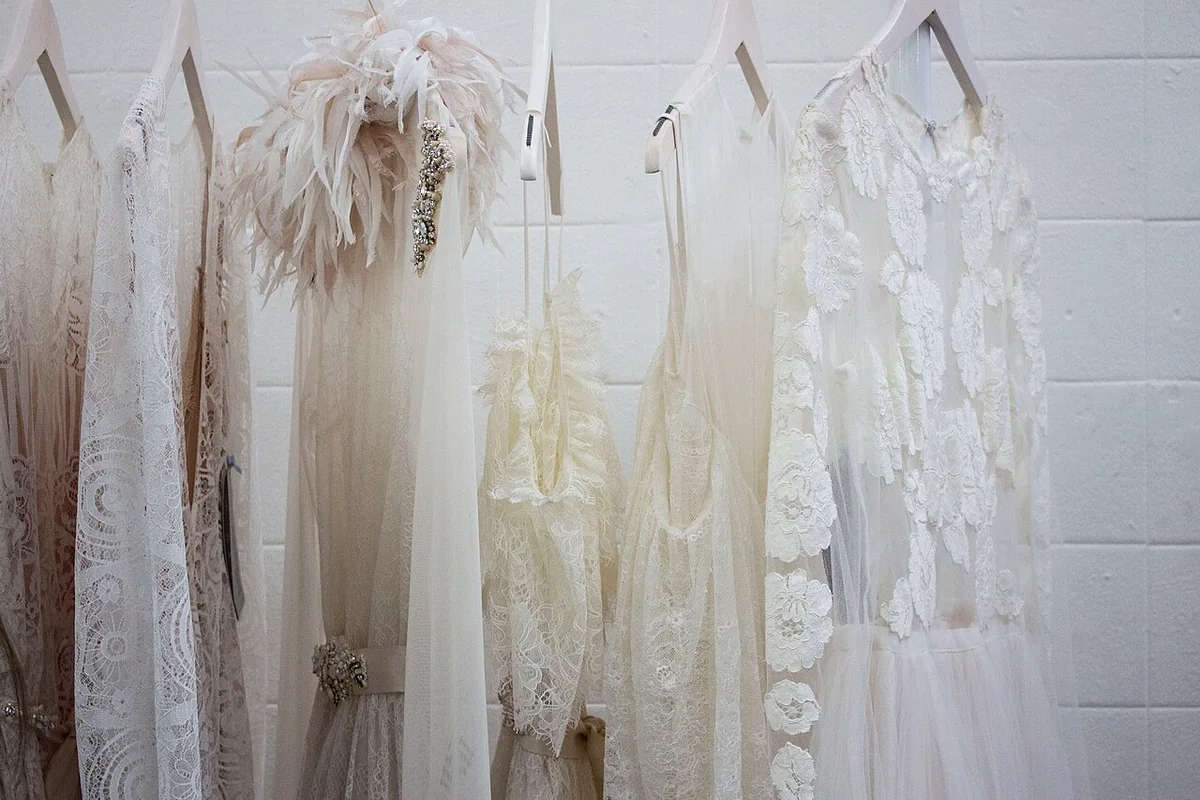
A row of pale wedding dresses hanging from a rail. Photo: Charisse Kenion charissek, Wedding dress fashion (Unsplash).jpg, CC0. Resized and converted to WebP; the image remains available under its original licence. This is an illustrative photograph, not a Vowlinora case study or a photograph of the worked example.
