A fitting should help the wearer assess clothing without requiring them to justify their body, identity or access needs. Before booking, ask the boutique concrete questions about the space, the available samples and how the appointment will work. A warm welcome matters, but it is not the same as a usable fitting arrangement.
Requirements differ by person and location. In the United States, the Department of Justice’s ADA guidance addresses access, effective communication and reasonable modifications for covered businesses. That is a jurisdiction-specific framework, not a universal legal statement about every boutique worldwide.
🤝 Describe what makes the visit workable
You can share practical requirements without offering an unnecessary medical history. Examples include step-free entry, a seated fitting, space for a mobility aid, written communication, a quieter appointment or assistance from a chosen person. Ask for clear confirmation rather than relying on the word accessible.
- Identify the features you need for arrival, changing and fitting.
- Ask the boutique to describe the actual route and room.
- Confirm sample availability in relevant styles and sizes.
- Agree communication preferences and consent before physical assistance.
- Plan breaks and any support you choose to bring.
- Confirm unresolved details before travelling.
Maggie Sottero notes that boutiques may have limited sample sizes and may use clips to approximate fit. Ask what you will realistically be able to assess. A designer’s advertised size range does not prove that the local shop has suitable samples ready to try.
A worked appointment request
Assume an illustrative shopper who uses a wheelchair and prefers a seated fitting. They want to compare skirts and necklines without transferring onto a raised platform. The following questions describe one person’s preferences, not a standard requirement for every wheelchair user.
| Area | Question | Useful confirmation |
|---|---|---|
| Arrival | Is the intended entrance step-free throughout? | Route description and any known limitation |
| Fitting space | Can the appointment work from my chair? | Room arrangement discussed in advance |
| Samples | Which suitable samples are available? | Actual styles and sizes, not catalogue range |
| Assistance | Can staff ask before touching or adjusting? | Agreed consent-based process |
If the shop cannot answer immediately, ask who can confirm the details and when. A photograph or measurement of the actual space may help, but should not be presented as a professional access assessment. The shopper decides what information they need to judge the visit.
Keep the fitting centred on the wearer
Tell companions how you want feedback handled. Ask staff to address you directly, use your chosen name and discuss clothing adjustments without unsolicited body commentary. Gender expression, coverage and styling preferences should be treated as part of the brief rather than assumptions to correct.
Physical assistance should follow consent and appropriate capability. Boutique staff should not improvise lifting or transfers. If a task requires particular support, discuss a suitable arrangement beforehand with the people involved; this article does not provide clinical or manual-handling advice.
For sensory or communication needs, ask about lighting, sound, appointment pace and written summaries. A quieter slot may be possible but should be confirmed, not promised by a general guide. You can also ask to pause or end an appointment that is not working.
Assess the actual garment
Try the positions and movements relevant to your day, within your comfort and the safe fitting setup. Ask the alteration specialist how construction, fastenings and length can be assessed for the way you will wear the dress.
Record any sample limitations and proposed adaptations before buying. Not every design can accommodate every requested change, and feasibility needs a specific assessment. A respectful consultation can still end with choosing another gown or another supplier.
The useful takeaway is a fitting arranged around the person rather than an assumed shopper: clear access information, appropriate samples, consent-based assistance and enough evidence to make your own clothing decision.
Sources and further reading
Photograph credit
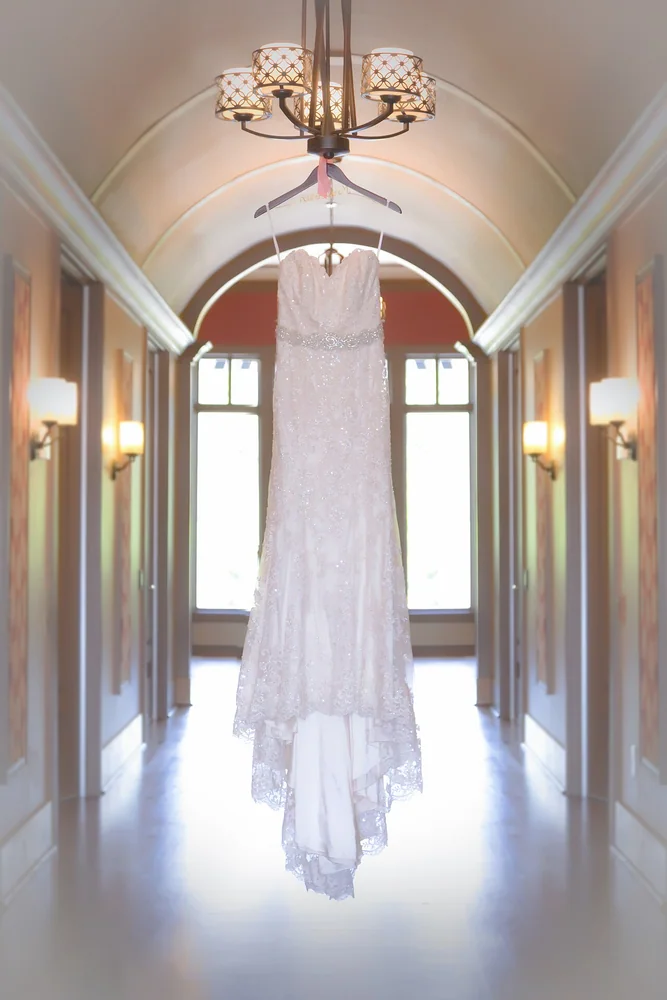
A white wedding dress hanging from a chandelier in a bright room. Photo: Mike&Noemi Gonzalez mikenoemi_g, Wedding dress hangs from chandelier (Unsplash).jpg, CC0. Resized and converted to WebP; the image remains available under its original licence. This is an illustrative photograph, not a Vowlinora case study or a photograph of the worked example.
