
A tasting is a focused conversation with food on the table. It can help you choose dishes and communicate preferences, but it cannot reproduce every condition of a full wedding service. Treat it as a decision meeting, not proof that the same plate will reach a large dining room in identical form.
Before attending, ask what the tasting includes. You may be comparing a final shortlist, sampling a seasonal menu or choosing among dishes prepared for several couples. Confirm the charge, attendees, dietary discussion process and whether changes requested afterwards are included in the eventual quote.
🍴 Use a scorecard with room for questions
| Dimension | What to observe | Question for the caterer |
|---|---|---|
| Flavour and texture | Your own preferences, described specifically | Can seasoning or accompaniments be adjusted? |
| Menu balance | Repetition, richness and contrast across courses | Does the complete sequence work? |
| Eating practicality | Cutting, bones, shells or awkward presentation | Is this suitable for the planned service? |
| Dietary options | Substance and thoughtfulness of alternatives | What needs separate confirmation? |
| Event execution | What the tasting cannot show | How will this be prepared and delivered at scale? |
Use a simple scale if it helps, but write a reason next to each score. ‘Too sharp for our preference’ is useful feedback. ‘Bad’ is not. Keep enjoyment scores separate from operational approval; a delicious dish can still require equipment or timing the venue cannot support.
Anchor the scores and explain the decision
Choose criteria before tasting and define what your numbers mean. For this fictional couple, flavour means personal enjoyment, texture means the eating experience, and ease of eating means managing the dish with the planned cutlery. None is a food-safety assessment. Use these preference anchors consistently, with intermediate scores of two and four where appropriate.
| Criterion | 1 | 3 | 5 |
|---|---|---|---|
| Flavour | Strongly dislike | Acceptable but not a favourite | Would choose enthusiastically |
| Texture | Unpleasant for our preference | Acceptable with a question or adjustment | Enjoy throughout the portion |
| Ease of eating | Repeated difficulty with intended cutlery | Manageable with some attention | Comfortably managed without awkward handling |
Suppose Dish A is a vegetable pastry with lentils and herb sauce. The fictional notes say “enjoy the filling; crisp pastry difficult to cut neatly.” Scores are flavour four, texture four and ease two, totalling ten. Dish B is braised vegetables with grains: “enjoy the sauce; would prefer more texture; easier to manage.” Scores four, three and four total eleven. These invented observations are not tasting results or approval of either recipe for any dietary requirement.
B is the couple’s provisional preference, not objectively better food. Their action record asks the caterer whether the grain texture can be adjusted, whether the venue supports the intended service, and whether the confirmed alternative meal will be equally substantial. The choice remains pending until the caterer answers. Do not hide a must-have condition inside a weighted average.
Copy these fields for each actual dish: dish/version; criterion scores; observed reason; requested adjustment; caterer response; service constraint; dietary discussion status; final decision and approver. A high score cannot close an unresolved ingredient or kitchen-capacity question. Record the approved version, so a later substitution triggers review rather than silently inheriting the earlier score.
For a plant-forward menu, discuss a complete main course rather than merely deleting one ingredient. JAM Catering’s published cuisine page is an example of dedicated vegetarian and vegan menu offerings, not proof that another provider offers the same dishes or controls. Your caterer must confirm the actual recipe and service.
Run the meeting in sequence
- Agree the shortlist and questions before the appointment.
- Record initial impressions independently before discussing as a group.
- Compare the complete meal, including the alternative course.
- Ask how the dish changes between tasting and event service.
- Discuss substitutions and dietary requests with the caterer.
- Request a written summary of the chosen menu and unresolved points.
A dish served immediately to four people may not demonstrate the same workflow as a room of guests. Ask about the intended service sequence without requesting unsafe holding experiments or making your own food-safety assessment. Staffing, equipment and temperature-control decisions belong to the catering team.
Keep dietary confirmation separate
Sampling a dish without a reaction does not establish that it is suitable for a guest with an allergy. Ingredient information, preparation and cross-contact controls require a separate discussion. GOV.UK’s allergy guidance for food businesses stresses accurate information and keeping it updated when recipes or ingredients change; local rules elsewhere may differ.
Finish by recording what was actually agreed: dish names, accompaniments, permitted adjustments and the process for seasonal substitutions. If a key ingredient is unavailable later, the caterer should know whether preserving flavour, appearance or a particular dietary arrangement is the priority.
The takeaway is to use the tasting to make clear choices and ask better questions. A scorecard is a memory aid, not a certificate of safety or a guarantee of wedding-day performance.
Sources and further reading
Photograph credit
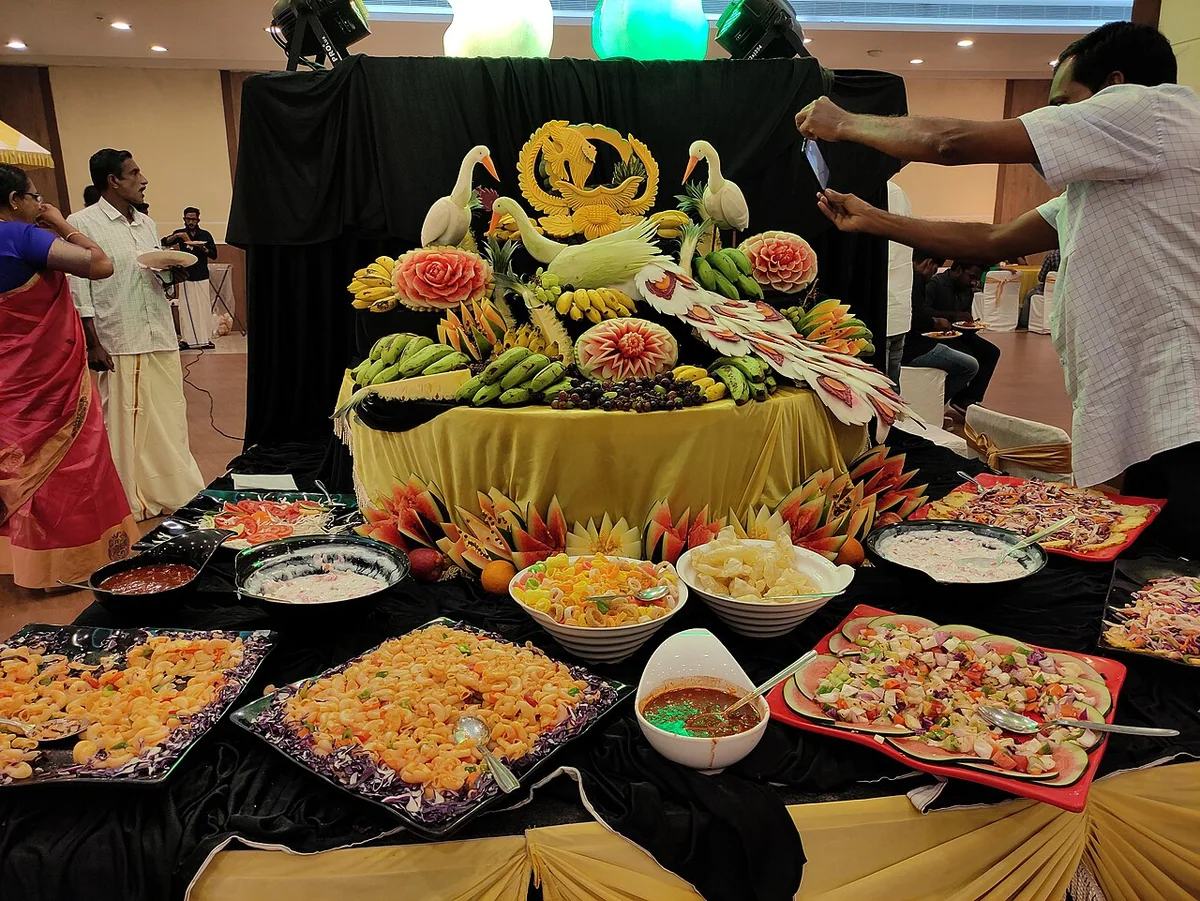
A wedding buffet display with salads and carved fruit in Kochi. Photo: Vis M, Salads at a Wedding Reception, Kochi, Kerala 03.jpg, CC BY-SA 4.0. Resized and converted to WebP; the image remains available under its original licence. This is an illustrative photograph, not a Vowlinora case study or a photograph of the worked example.
